Neil DeGrasse Tyson and mass shootings

Neil DeGrasse Tyson is the director of the Hayden Planetarium at the American Museum of Natural History. He has a PdD in astrophysics. Although he has published research papers, the last one I could find was in 2008. These days he is known for his popular books on science, and as a science popularizer on TV, radio and online. That in itself is not a bad thing; in fact, it is a very good thing to do, assuming it’s done well.

As a famous person (at least in some circles), Tyson apparently often makes public statements regarding current events. One of his recent statements, delivered via Twitter, has been the object of criticism. Here is Tyson’s tweet:

“In the past 48hrs, the USA horrifically lost 34 people to mass shootings. On average, across any 48hrs, we also lose…

  • 500 to Medical errors
  • 300 to the Flu
  • 250 to Suicide
  • 200 to Car Accidents
  • 40 to Homicide via Handgun

Often our emotions respond more to spectacle than to data.”

I have a PdD in atmospheric science. I am neither a working scientist nor a famous public figure. You won’t find any research published by me after my dissertation. None of the work I did for nearly 30 years was pure science, and none of it will ever be published in any open literature. Not that anyone would be interested. But I, too, have opinions about current events, although I seldom publish them on this blog. I make an exception in this case. Here is my response to Tyson’s tweet:

Tyson’s statement isn’t even nonsense. It’s basically just a list of facts followed by a non sequitur. A list of facts is meaningless in itself without a relevant conclusion. It reminds me of something I saw in graduate school. A doctoral candidate does research (hopefully original), analyzes the data and then draws a conclusion in his dissertation. Then the dissertation must be defended before a reading committee. I attended the defense of one of my fellow students. At that meeting he went through his data, and there was a lot of it. He then applied a lot of statistical analysis. And then he stopped. One of the committee members asked what his conclusion was. He had none. They told him to go back, finish his work, draw some meaningful conclusions, and then come back to defend his work.

I was surprised that his advisor had allowed him to reach that stage without doing the very thing that a dissertation is supposed to do, which is draw conclusions.

All the data in the world is meaningless without some kind of analytical conclusion. Tyson gives us “Often our emotions respond more to spectacle than to data”? What does that even mean? Does it mean that mass shootings are spectacle? Does it mean that we should look at lists of data rather than reports of a mass shooting? Does it mean that the deaths of 34 people from one cause is not important because more people have been killed from other causes? Is it merely an academic observation on the failings of human nature? Is it a Delphic pronouncement from on high?

He issued an apology on Facebook with some explanation for what he intended. His apology was even worse. Here it is:

“My intent was to offer objectively true information that might help shape conversations and reactions to preventable ways we die. Where I miscalculated was that I genuinely believed the Tweet would be helpful to anyone trying to save lives in America. What I learned from the range of reactions is that for many people, some information–my Tweet in particular–can be true but unhelpful, especially at a time when many people are either still in shock, or trying to heal–or both.”

This is not nonsense, but it is bullshit. I assume that his list of causes of death is accurate (it seems to be reasonably accurate, although it is not an exhaustive list of preventable deaths), but in what way does that help shape conversations and reactions? In what way could it possibly be “helpful to anyone trying to save lives in America”?

He says “for many people some information … can be true but unhelpful…”

Really? Subtle dig there, right? I guess “many people” are not smart scientists like he is. Perhaps he should not have been so subtle.

Since he can’t seem be bothered to give us any conclusions, we are left to come up with some meaning on our own. In that case, why does Tyson even bother to tweet? It adds nothing to the public debate about a serious health and policy issue. It adds nothing to the problem of suicide. It adds nothing to the problem of medical errors. It adds nothing to our understanding of causes of mass shootings, or any of the other causes of death, for that matter. It tells us nothing about what we might think or do about any of these causes of death. It adds nothing because most of those causes of death are completely unrelated, and efforts to reduce those numbers would also be completely unrelated. Trying to reduce medical errors has nothing to do with trying to reduce the incidence of mass shootings. What is the flu doing in the list? How are we supposed to relate deaths from car accidents to deaths from mass shootings? Are we supposed to tackle all of these causes of death one at a time, starting with the biggest numbers and proceeding to the smallest? Can we not work on, let’s say, two at a time? Or even three? Or maybe even all of them?

I think Tyson has fallen prey to a weakness that other scientists have. It’s the idea that because they know, understand, and can speak authoritatively about some particular subject, they must be able to speak with authority about any other subject. There are enough counter examples that a science popularizer ought to be familiar with the dangers inherent in that belief. I guess he felt like he had to say something, and it had to be sciencey. Unfortunately, it seems that even coming up with something that reaches the level of nonsense is beyond him.

My understanding is that Neil DeGrasse Tyson does not do actual scientific research any more. If this tweet is an example of how he would apply his knowledge and analytical skills to science, then it’s probably a good thing he’s no longer a scientist.


Roseanne was right

The dishwasher at our old house was very loud. We couldn’t hear the television when it was running, and since our bedroom was close to the kitchen, we wouldn’t let it run after we went to bed. So it was kind of a hassle.

At our new house, we looked for a quiet dishwasher. We found one that wasn’t quite as quiet as the quietest, but which was quite quiet. It was nice. We can barely hear it operating and can easily watch television with it on, even as close as we are to the kitchen when we watch television. But it also has a delay feature, so I can set it to turn on at 2 or 3 in the morning. Our bedroom is now at the opposite end of the house, which is not all that distant from the kitchen, but we never hear a thing when the dishwasher rus. Nothing at all. It’s great.

So, on Tuesday night I set the washer to come on at 3 am. We had filled it with all of my juice glasses, a whole lot of cups, lots of saucers, and almost every single utensil we have. On Wednesday morning I came into the kitchen and opened the washer. The first item I took out was dirty. Great, I thought, what did I do, obstruct the washer’s water spray? Then I looked at some plates. They were dirty. Unwashed. And then I realized that none of the control lights that should have been on were actually on.

Great. The washer is not working. It looked like there was no power, so I thought maybe the electrical plug had come out. I unscrewed the washer frame and pulled it from under the counter. Nope. It was wired directly with no plug. I went downstairs and with Leah’s help identified the circuit breaker that controls the washer. It was fine. I turned the power off, hoping maybe it would wake the washer up when I turned it back on, but no luck.

With a little online investigation I found some instructions for checking the controls. I activated a sequence of buttons, and all the lights came on, and then what looked like an error code appeared on a screen. A little more investigation convinced me that our problem is almost certainly a failed circuit board. I ordered one online and we’re waiting for it. It looks like a fairly easy replacement.

In the meantime, we’re washing dishes by hand. The load I unloaded after it didn’t get washed did, indeed, include virtually every utensil we own, plus some that a stray hobo must have put in the washer while we weren’t looking. I’ve never seen so many utensils. We must be rich or something. I remember washing large quantities of dishes by hand, but it’s been a long, long time.

This makes me wonder, just a little, only a little. We had our noisy washer until we moved, so from 2005 until 2017. Twelve years without a problem. It was noisy but it lasted. Now we have a very quiet washer, and it lasted two years.

Oh well. It’s like Roseanne Roseannadanna said, “That just goes to show you, it’s always something.”

Those of us who are of a certain age are probably aware of Gilda Radner’s Roseanne Roseannadanna character on Saturday Night Live. She had a number of relatives, including her Nana Roseannadanna, her aunt Pollyanna Roseannadanna, her “musically happening cousin” Carlos Santana Roseannadanna, her religious aunt Hosanna Roseannadanna, and her singing cousin Lola Falana Roseannadanna.

Leah and I miss Roseanne, as well as Emily Litella. We wonder what Gilda would be doing now if she had lived.

A slow walk home

Zeke has been our dog for about 13 years, and he was around even before that. He was grown when we first saw him across the road from our house. So he’s probably around 14, which is quite old for a big dog like him.

The deep brown patch centered on his right ear is graying, but he has always behaved like a young dog. He’s up at the barest hint of action. He’s ready to go out for any reason, and always ready for a ride in the truck. He rough-houses with Sam on our walks. If not for the gray, you would never guess his age.

Until Tuesday. On Tuesday we left the house around 9:30 for our regular morning walk. We turned down Fouche Gap Road and headed down into Texas Valley towards the bottom of the mountain as usual. I let the dogs operate on dog time. That means we stop for interesting odors, and we make sure to mark various limbs and blades of grass, just in case another dog should happen along. At that pace, it takes about 30 minutes to make it to the bottom of the mountain. At the bottom of the mountain we stop for a minute, and then we turn around. Turning around is usually a sign for Sam to start nipping at Zeke and dancing around him. Sam growls and they bite each other on every surface they can reach. Sam does most of the work, but Zeke does his part, too.

But that didn’t happen on Tuesday. Zeke turned around and began a slow trudge back up the road. My pace is usually somewhere between a dog walk and a dog trot, so the dogs will trot for a short distance and then slow down to walk for a time. But on Tuesday Zeke walked slowly and deliberately, putting one foot down and then another. When Sam invited him to play, he barely acknowledged it. It took 45 minutes to get back home, and I was wondering the whole time whether he would make it. I was thinking about how to get Leah to come and pick us up. Zeke just wasn’t himself.

Or rather, I guess Zeke was himself, only it’s now his older self. I’m afraid this means no more long walks. We won’t walk down Fouche Gap Road; instead we’ll go up the mountain to the top, a fairly short walk, and then, when we turn around, it’s all downhill back home.

I have wondered how long Zeke would be able to keep up with Sam, and now I guess I know.

This is Zeke today.

This is a shot from about two years ago.

Buried Treasure

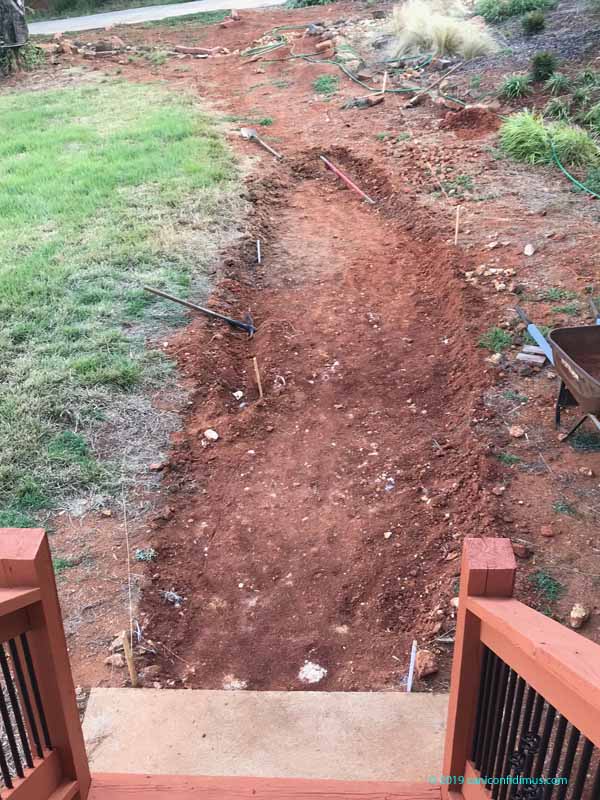
I have been doing some other things, so I haven’t made much progress on our front walk. I got back to it on Sunday. I was digging out about 10 feet from the bottom of the front steps when I hit concrete. It was our septic tank.

I knew the tank was somewhere around there, but I thought it was a little further from the steps and the front of the house. Hitting it there means I have to curve the walk around it, since I don’t want the walk to be actually on the septic tank. I suppose an arrow-straight walk looks best, and is easier to lay, but I was going to have to curve it around the base of the slope anyway. This new curve will give the walk a serpentine look, which might look good if I can pull it off.

This is where I left the work on Monday. The walk has to curve around those dead-looking ornamental grasses. I hope I can make the curves smooth.

There are two stakes on the left side of where the walk will go. They mark the corners of the septic tank. At the end of the excavation on the right there is a collection of what looks like rocks. That was the second buried treasure I found.

I was digging along, going pretty well, when I started hitting what I thought were rocks. Most of the native sandstone where I’m digging is soft enough to actually slice through with the shovel. These rocks were not. When I started digging them out I found that they were broken-up pieces of concrete. That’s the material the grader used on our driveway during construction. It’s a lot cheaper than crushed stone, and it’s available a lot closer. It’s also bigger than crushed rock and a lot uglier. The driveway, fortunately covers most of what was there when we first moved in, but there are still deposits here and there. This was one of those deposits. It might have been put there to keep the trades people’s trucks from parking in the mud. It was eventually covered when the front yard was graded.

It is a problem because even when I break up the dirt with a pick, I can’t get the shovel through it because of the pieces of concrete. I have to use a hoe to drag the dirt out, then pick through it to find the rocks and toss them aside.

I would rent a small backhoe for this work if I didn’t have to worry about the septic system leach field. We have already had to have a repair done from when someone parked on the leach field and collapsed the drain lines. So it’s going to be dug by hand.

Well, OK, the septic tank and the crushed concrete were not really treasure, but they were buried.

Thunderstorm in the distance

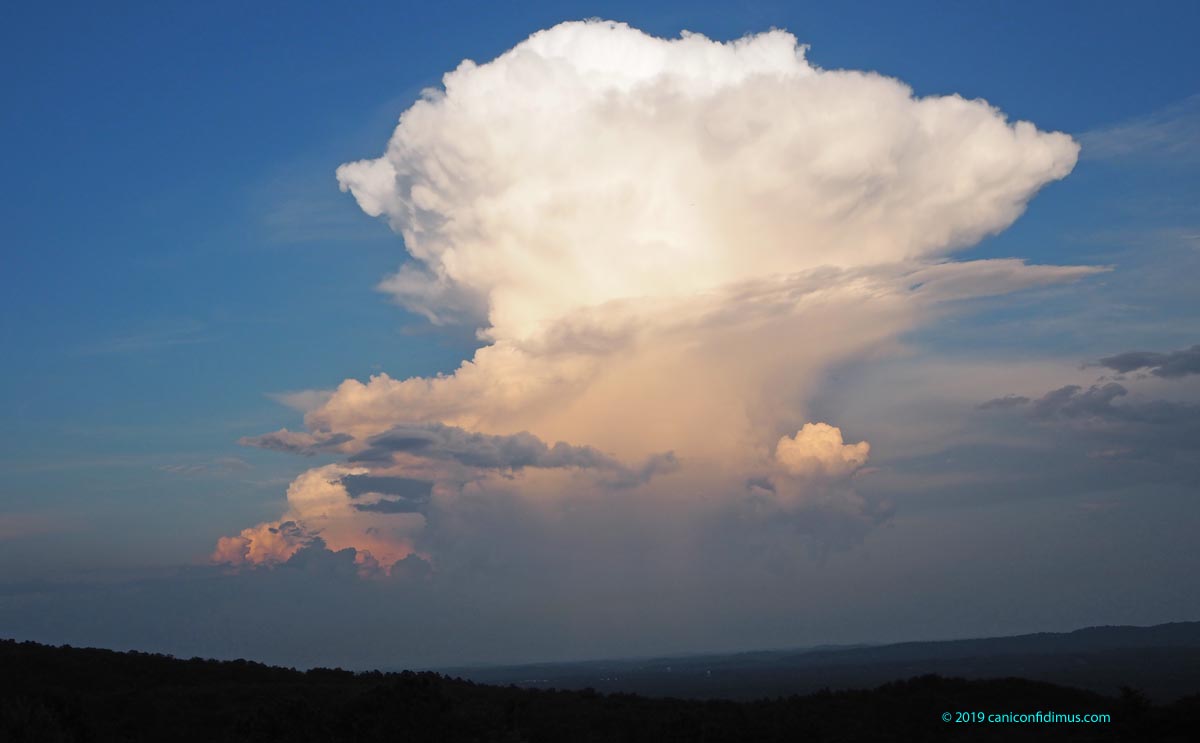
Wednesday afternoon a thunderstorm appeared within a matter of about 45 minutes to the east of us. I walked out on the front porch and told Leah to come out and see a classic thunderstorm anvil cloud.

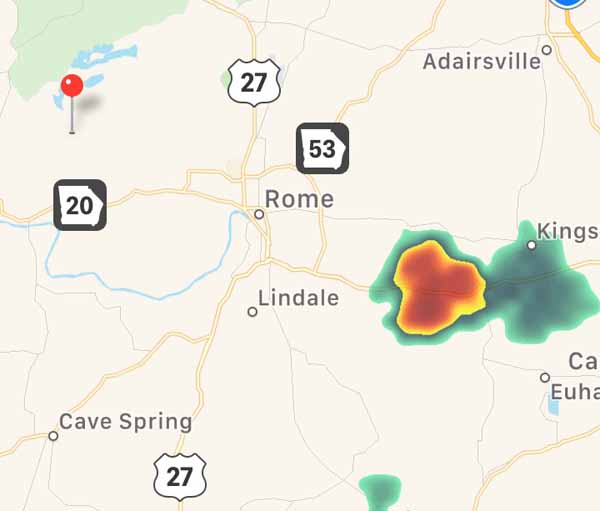
It was late enough in the day that the shadow of the Earth was creeping up the base of the cloud. There was an occasional lightning flash beneath it. I checked my phone’s weather radar app to see how far away it was.

The pushpin shows our house. The storm was about 15 miles away. Unfortunately it was not heading our way. We have experienced a few light showers lately, but the strong storms have avoided us. We are very dry up here on the mountain top. I would like a light rain that lasts for a couple of hours, but I would settle for a heavy rain that lasts for 30 minutes.