The last of the storm

When you wake up in the morning and the first question you hear is, “What happened to the clock,” it’s not a good sign.

It had continued to snow Wednesday night, and by early Thursday morning, the top of Lavender Mountain was a winter wonderland. A quiet, dark winter wonderland. We lost power sometime during the night. We were one of many all over Rome and the surrounding area.

I measured seven inches of ice and snow on the deck railing. Everything in sight was covered by snow, including the roads. The pines were all sagging and several had simply snapped. One in our leach field had broken at the base. Fouche Gap Road was blocked going down into Texas Valley, and would have been blocked on the town side if someone had not used a chain saw to clear a downed pine.

As bad as it was, it could have been much worse. A little more snow, a little more ice, and it’s likely there would have been many more outages and a lot more trees down. According to the Atlanta TV stations, about a million people lost power, from Atlanta east towards Augusta. A fairly large number were still without power Friday afternoon.

We have a generator, so we could keep track of what was going on 70 miles away in Atlanta, but not, of course, what was happening down the road in Rome. The generator let us keep the refrigerator and freezer going. I don’t have the 220-volt well pump set up to run off the generator, so a long-term power outage would be a problem for us. Around mid-afternoon we were making plans to go to my mother’s house to fill up water containers when the power came back on. It was a pleasant surprise. There are only 10 houses on top of the mountain; that’s not a lot compared to the many neighborhoods without power all around us.

All in all, we didn’t have much to complain about. It was very beautiful while it lasted.

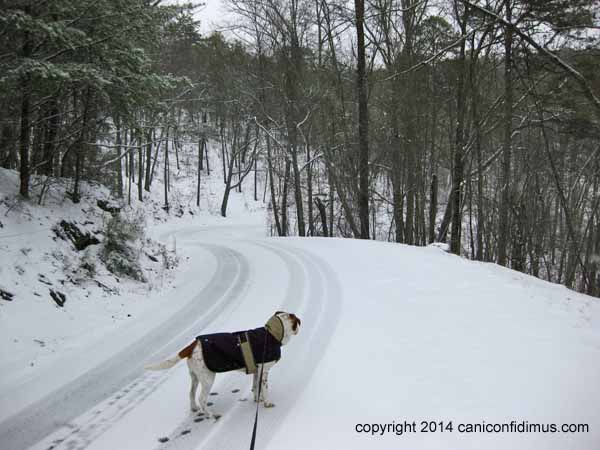
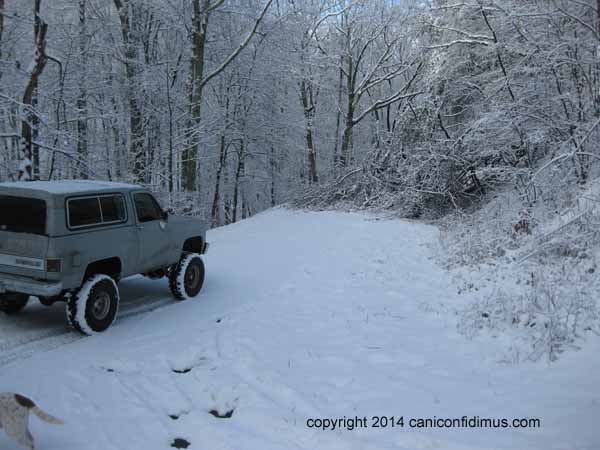
I walked Zeke partway down Fouche Gap into Texas Valley, far enough to see the big pine across the road. The son of one of our neighbors managed to get the left side of his four-wheel-drive into a ditch, and we weren’t sure he was going to get out. He did, but the big pine a little further down stopped him. He walked the rest of the way down the mountain to his home.

Thursday evening we drove down into town to have dinner. The roads at the bottom of the mountain were completely clear and there was almost no snow anywhere except in deep shade. It was a different world from up on top of the mountain.

By Friday morning, most of the snow was gone up here. The roads were clear, almost all the snow had melted off the trees, and the only snow on the ground was in the shade. We’re running short of firewood, but I found some more old, dead cedars and a couple of smallish, dead trees that I think are black locust. So we’re set for some more cold weather, but right now at 8 PM it’s 43 degrees and rain is falling. Our storm is over.

Here are a few pictures I took Thursday morning before the melt began. This is the view down our driveway.
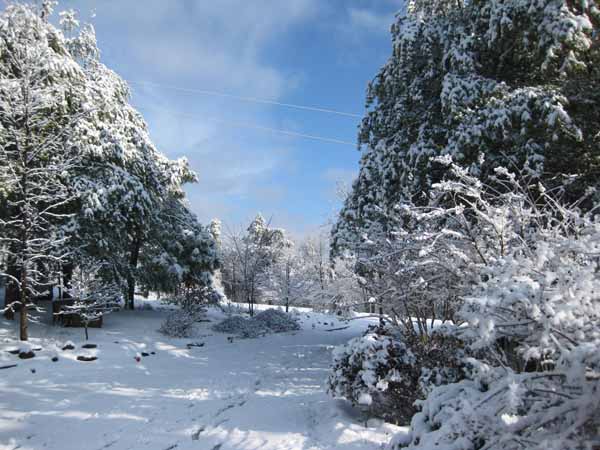
driveway

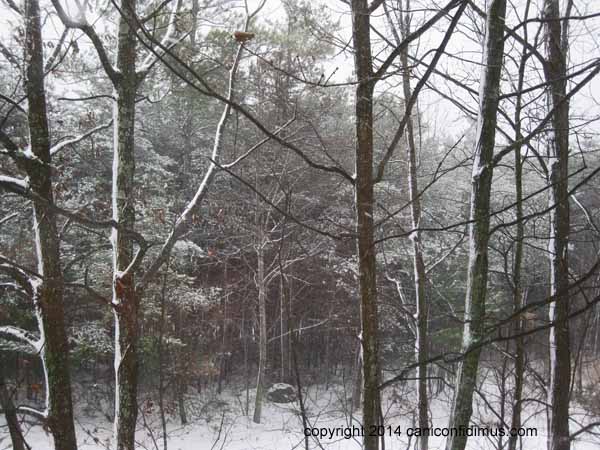
This is looking towards the woods at the back of the house.
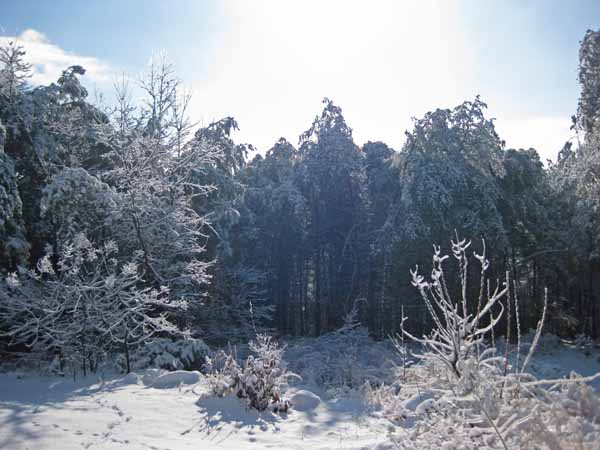
back_yardThis is on Fouche Gap Road looking towards Texas Valley.
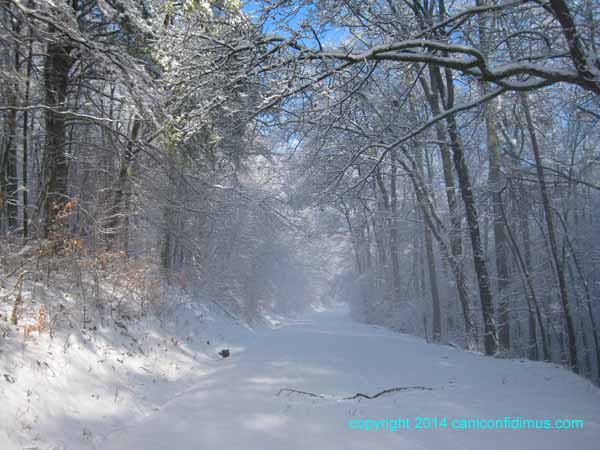
down to texas valleyThis is the pine that stopped our neighbors’ son on his way down into Texas Valley. that’s Zeke’s rear end. This is the more northerly side of the mountain, so it stayed snowier longer than the road leading down to Huffaker Road and town.
downed pine

Winter Storm: Day 2

Wednesday morning was the intermission between Act I and Act II of our winter storm. The headlines and the Atlanta TV stations were calling it a catastrophic storm, and it may actually be that. According to the news, a lot of people lost power. The Atlanta TV stations have concentrated on the interstates inside the city, so all we know about what’s going on in Rome is what we can see from our deck, and that’s not much.

The temperature hovered around freezing all day. When I walked Zeke around 10 AM, there was a light mist falling. There was about 1/16 inch of ice on the trees and a little slush here and there on the road. At the bottom of the mountain there was no ice on the road and little ice on the trees. The light precipitation (freezing rain, sleet or possibly grauple) continued all day, and by late afternoon there was about a quarter inch of ice on virtually every surface. The trees were beginning to droop. Apparently a quarter inch of ice is enough to interfere with the signal for satellite television. I had to pour hot water on the dish to get a signal.

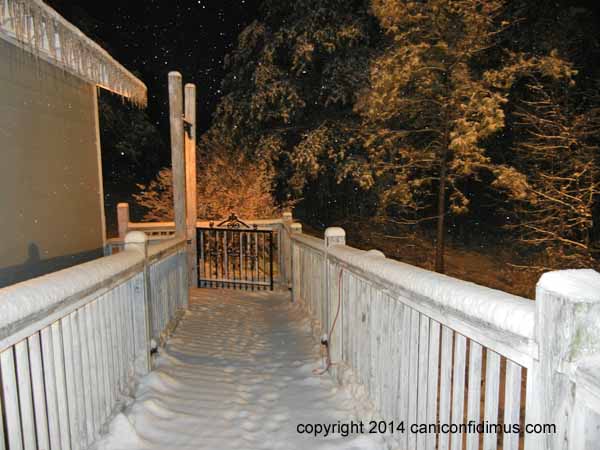
By about 7 PM, when I was getting ready to take the dogs back out, Leah said it was snowing again. And it was snowing lightly. All the ice, slush, and melted and refrozen snow were covered by about an inch of new snow. Everything was white, including the roads. Unfortunately, the new snow was making the tree limbs sag even more. As of 9:30, there was still light snow, enough to soften the footprint I made when I took the dogs out an hour and a half earlier. I have to admit, a completely snow-covered scene like that is pretty.

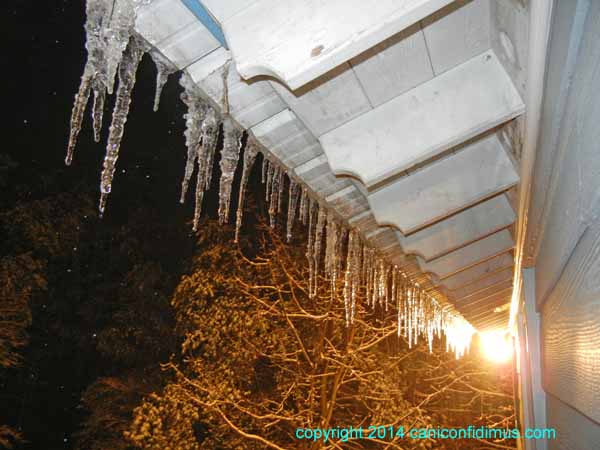
Icicles formed on the roof overhang early in the day. They have continued to grow.

icicles

This is our front walk. It’s elevated, so it cools quickly. The first snow shoveled off fairly easily. Then the freezing rain during the day made it so slippery I went in and out through the garage. Now the snow has made the footing safer, at least temporarily.

snow on front walk

It will be interesting to see if the next wave gives us more snow by morning.

The low tonight is supposed to be around 30. It’s supposed to clear by Thursday afternoon and reach the 40s. And then it will be over.

Winter storm: Day 1

We’re in the middle of a winter storm here in Georgia. The first wave hit Monday night. When we woke up Tuesday morning, there was snow on the ground and it was still coming down. By around 10 AM there was three and a half inches on cold surfaces. This was the view out of our bathroom window.

out the window

I took the dogs on a walk around the house as usual. Later I took Zeke for his regular walk down Fouche Gap Road. Lucy is too sensitive to cold, so I left her at home. On the streets up on the mountain there was a layer of snow over a layer of slushy ice.

I made Zeke wear his winter coat.

zeke on the snow

It stopped snowing around noon. The temperature rose a little and just reached freezing by afternoon. The roads on the mountain were essentially free of snow by mid afternoon. There was an interesting dynamic at work on the roads. The roads were above freezing when it started snowing, so the snow melted as it hit the surface. Enough snow fell that the melted snow formed slush. By afternoon, there was enough solar heating, despite the total cloud cover, that the snow mostly disappeared. But by then, it had been cold enough for long enough that the slush was freezing. As I write this at 8 PM Tuesday, the temperature has actually risen to just above freezing, but I think by Wednesday morning the slush on the roads will be solid up here on the mountain. But that will be OK. I’m retired now, so I don’t have to worry about getting stuck in Huntsville.

Forecasts call for a severe ice storm with the northern boundary just south of us. We may get more snow, but it looks like the worst of the ice will miss us. That’s good. If the area south of here gets as much ice as they call for, things could get very ugly. The last time there was a really bad ice storm here was back in the early ‘60s, and we were without power for about a week because of downed power lines.

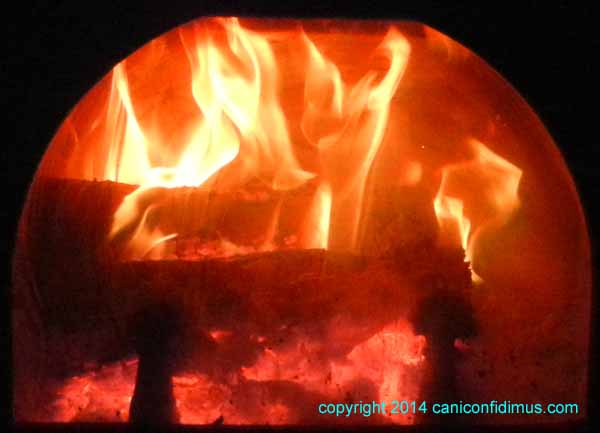
I don’t think we’ll lose our power, but just in case, I was able to find some more oak for firewood. It’s a little green, but the aged cedar I cut up a few days ago burns so well that it helps the oak.

wood burning stove

We’ll see what we see when we look out the window Wednesday morning.

Question answered

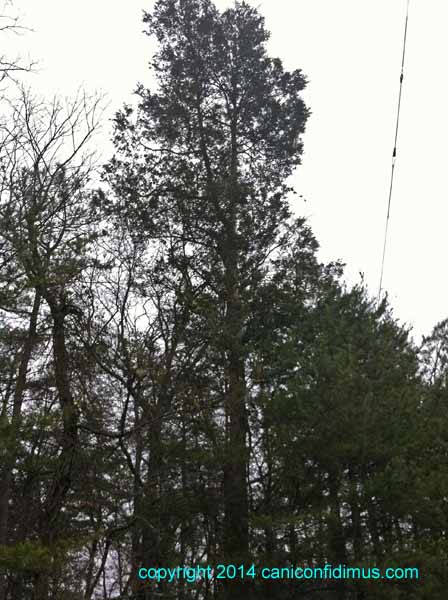
Wayne identified the dead trees I mentioned in my post yesterday as eastern red cedar (juniperus virginiana). Once I read his comment, I realized I should have been able to figure that out. As I said, it didn’t occur to me because there are no large cedars nearby. There is, however, a large cedar about a hundred yards up the street that I have noticed on many occasions. Here it is.

mature_cedar

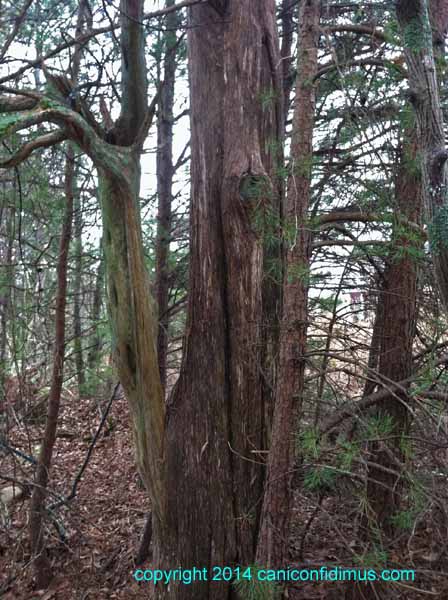
Here is a closer view of the tree’s bark. If you compare it to the wood in the wheelbarrow from yesterday’s post, you can see the similarity.

cedar bark

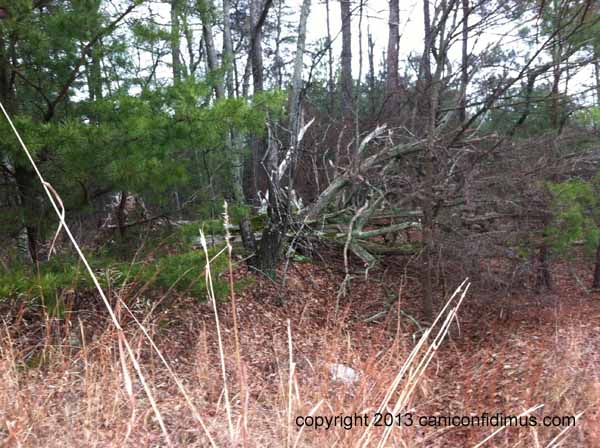
Next to it is a dead cedar that looks amazingly like the ones on our property.

dead cedar

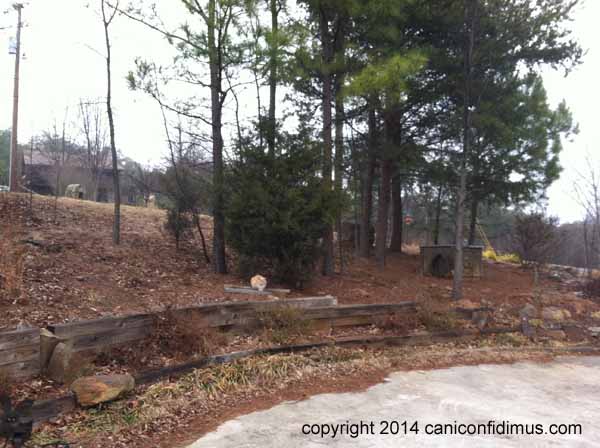
Although there are no large cedars nearby (assuming 100 yards is not nearby), there are several young cedars, like this one I can see every time I walk out onto our driveway.

ouryoungcedar

How could that have escaped my notice? That’s Dusty perched in front of the little cedar. Maybe he could have helped with the tree identification.

When I walked the dogs this morning I looked for cedars. I saw two or three small ones, about the size of the one by our driveway, but no large cedars. The woods are wide open this time of year, so I am pretty sure I would have been able to identify a cedar if I had seen one in the woods.There must be other mature cedars around the mountain, but the one up the street is the only one I can specifically remember. I remember this one in particular because I don’t remember seeing any others.

I know where baby cedars come from, but I don’t really understand why the nearest mature cedar is so far from our young ones, and especially so far from the two or three I saw on our walk. Squirrels? Birds?

I went down Wildlife Trail later in the afternoon and looked up into our property. There are more dead cedars lying on the ground than I realized. I wonder how they died. Are cedars more susceptible to low-level fires than pines? If the fire that charred our loblolly and short-leaf pines also killed the cedars, it must have happened longer ago than I thought. I am going to have to assume that I can’t accurately estimate the timing of these events.

This also makes me wonder about what the forest looked like in the past. It’s mixed oak, hickory and pine now. I don’t think much if any of the mountain is virgin forest, and there are some large areas that have been cleared in recent decades. But based on the size of some of the trees along the road and not far from our property, much of the forest has been undisturbed for quite some time, especially on the steeper slopes. I’m guessing that logging ended in the early 1900’s, or possibly even in the late 1800’s (but we know how unreliable my time estimates are). The longleaf pines down Wildlife Trail give some evidence that in the more distant past there were larger stands of longleaf. I wonder how the cedars fit into this picture.