IBS

It’s a condition that affects many, many people, but it’s never talked about, and as far as I know, there is no research on the subject. It’s embarrassing. Many people are hesitant to even to mention it. Doctors don’t seem to be inclined to help, if you can bring yourself to talk about it. The few treatments aimed at similar conditions don’t seem to help much, so most of the afflicted are left to suffer on their own. The condition is, of course, IBS – Itchy Back Syndrome*.

I have to wonder: how many people you see every day walking through the store or driving along the highway are IBS sufferers? You might see someone reaching around as far as they can for that spot on their back that’s just a little too far away. Why does it seem that the itch is right in the middle of the back, too far to reach from any direction? Especially since most sufferers are older and not as limber as they used to be.

My father was an IBS sufferer. I can picture him now standing in the doorway, rubbing his back against the door frame, like a bear scratching on a tree.

I never thought I would have it, but I do now. And so does Leah.

We’re among the lucky ones who can talk about the problem. Now we both understand that old saying, “You scratch my back, and I’ll scratch yours.”

* I know that a lot of people suffer from a more serious version of IBS, that collection of symptoms known as irritable bowel syndrome. Leah was once diagnosed with IBS. That’s when I learned that there isn’t much that doctors can do about the “real” IBS either. In Leah’s case, her problem turned out to be a bowel obstruction caused by scar tissue from the colon cancer she had back in the late ‘90s.


Not such a good idea

Some of the blogs I follow set what I consider a good example in avoiding political posts, and when I started this blog, I intended to follow their lead. But recently Georgia began offering specialty car tags with a Confederate battle flag theme for the Sons of Confederate Veterans (SCV), and I don’t want to let that pass without saying something about it.

According to the Sons of Confederate Veterans (I debated linking, but I want anyone who wants to be able to read the things I mention), the tag commemorates Southern heritage. I tend to take people at their word, so my original intent in writing this post was to question exactly what they meant by Southern heritage. I assumed they meant what people usually say they mean when they talk about Southern heritage. You know, chivalrous plantation owners sipping bourbon on their front porches, or fighting and dying heroically for a noble but lost cause, or just the polite manners of Southern society. I was going to ask about other aspects of Southern heritage, like slavery; Jim Crow; lynchings; racial discrimination in voting, education, and public services; or laws that prevented blacks from drinking from the same water fountains as whites, or eating at the same restaurants, or staying in the same hotels. I was going to contrast what I assumed was their view of Southern heritage with a grimmer view of it.

But then I read their Web site.

There I learned about General William Tecumseh Sherman’s war crimes, Little Mary Phagan Day in Georgia, the Lincoln movie myth, and the removal from the grounds of the state capitol of a statue of a post-Civil War politician named Tom Watson.

Sherman’s war crime was removing about 400 mill workers from near Atlanta and shipping them north, where most of them disappeared forever. According to the SCV, at least some of these 400 mostly women workers died on the trip.

Mary Phagan was a 13-year-old mill worker who was raped and murdered in 1913 at a pencil company in Atlanta where she worked. On the day she was murdered, she was going to collect her wages of $1.20 and then was going to attend a parade celebrating Confederate Memorial Day. This was apparently enough connection for the Georgia Sons of Confederate Veterans to designate a day to honor her.

The myth of the Lincoln movie is that Abraham Lincoln wanted to free the slaves with the Emancipation Proclamation, when in fact, all he really wanted to do was win the Civil War.

Tom Watson was a post-Civil War politician in Georgia. According to the SCV, he was a populist, a champion of the poor and an opponent of socialism and communism. They were offended when current Governor Nathan Deal removed a statue of Watson from the state capitol grounds.

The SCV Web site tells us about these things, but it fails to tell us more of the story, and in that failure, tells us more about the Sons of Confederate Veterans.

First, William Tecumseh Sherman apparently did arrest and remove about 400 mostly women mill workers, and apparently few are known to have returned home after the war. The Web site civilwartalk tells a somewhat different story from the SCV Web site. According to the civilwartalk account, the workers were allowed to take what they could from the company store before it and the mill were burned, and were then taken to a temporary camp in Marietta (where, the story goes, a Union officer ordered a Union soldier to return a family Bible that he had taken from one of the female workers.) The workers were then taken to Kentucky where they were given the chance to swear an oath of allegiance to the United States and then to work at factories in the North. Many apparently accepted this offer and never returned home. Perhaps not quite up to modern standards of military behavior, but not quite the atrocity portrayed by the SCV.

The story of Mary Phagan is notable mainly because of the fact that Leo Frank, a northern Jew who was a superintendent at the plant, was convicted and sentenced to death for the crime amid a great deal of publicity both in the North as well as the South. His sentence was commuted by the governor at the time because of grave doubts about his guilt, thereby ending his political career, and apparently his residency in Georgia for 10 years. Some of the most notable citizens of Marietta objected to that miscarriage of justice by forcibly removing Frank from the state prison, taking him back to Marietta and hanging him. In some quarters, Leo Frank’s most serious crime was that he was a Northerner Jew who was a superintendent at a Southern factory.

In the SCV account of what they call the myth of the Lincoln movie, they argue that Lincoln felt basically the same about slaves as everyone in the South, and only issued the Emancipation Proclamation as a way to further the war against the Confederacy. They quote an 1862 letter in which Lincoln says his main goal was to save the Union, and he would free slaves if that helped, or not free slaves if that helped.

The SCV might have made a more convincing argument if they had left it at that, but they didn’t. They continued to advance their story by saying that slavery had nothing to do with southern secession and the Civil War. The words of the secessionists themselves contradict that claim. One of two documents issued to justify the secession of South Carolina was titled, “The Address of the people of South Carolina, assembled in Convention, to the people of the Slaveholding States of the United States.” Why do they call themselves that? Well, in addition to objecting to the United States becoming a democracy, and objecting to majority rule, and objecting to having to pay taxes, they also fear that the non-slave-holding states will end slavery. The paper says that “the most civilized and prosperous communities, have been impoverished and ruined by anti-slavery fanaticism.” The paper also says, “In spite of all disclaimers and professions, there can be but one end by the submission of the South, to the rule of a sectional anti-slavery government at Washington; and that end, directly or indirectly, must be–the emancipation of the slaves of the South.” It seems pretty clear that the Southerners feared that they would lose their slaves, so they had to secede. So, there is a myth here, but it’s the myth that the Civil War was not about slavery.

The Tom Watson story is also a little more complicated than the SCV would have it. He started as a populist, but he ended up as a supporter of a renewal of the KKK. He originally advocated for letting blacks vote, but ended up advocating the disenfranchisement of blacks. He also agitated for the lynching of Leo Frank and celebrated it in his newspaper after the fact. He wrote anti-Catholic and anti-Jewish articles for his newspaper. So he’s not quite the hero the SVC says he is.

When I was young, I had a Confederate battle flag hanging in my window. I played with a set of blue and gray plastic Civil War soldiers (gray always won after desperate battles). I laughed when people talked about “The War of Northern Aggression.” And then I learned a few things about the Civil War and it wasn’t so funny after that. But the SCV isn’t talking about fun. My opinion is that the Sons of Confederate Veterans want a Confederate battle flag on their car tags because they’re unreconstructed. They consider the old days of the South better than today, and they would love to go back, not just to the romantic, mythical Old South, but to the real Old South.


Don’t worry, I’m not going to make a habit of this.
Leaf bath

Leah and I don’t have kids, but we do have dogs. Ever since I got my dog Jesse back in 1979, I have noticed similarities between the way kids and dogs behave. I’m afraid I might have offended some people who have kids by that observation, but I don’t think it says anything bad about kids or dogs. I like dogs, so I would probably like kids, at least if they act like dogs.

If you believe what you see in the movies, in television commercials and in comics, kids love to jump in piles of fall leaves. I’ve never done it, but then when I was growing up we had mainly pines. I don’t think you’re supposed to jump into piles of pine needles. Based on Zeke’s behavior, if my observational theory of the parallel behavior of canines and young humans is valid, that picture of kids jumping into piles of leaves may be accurate.

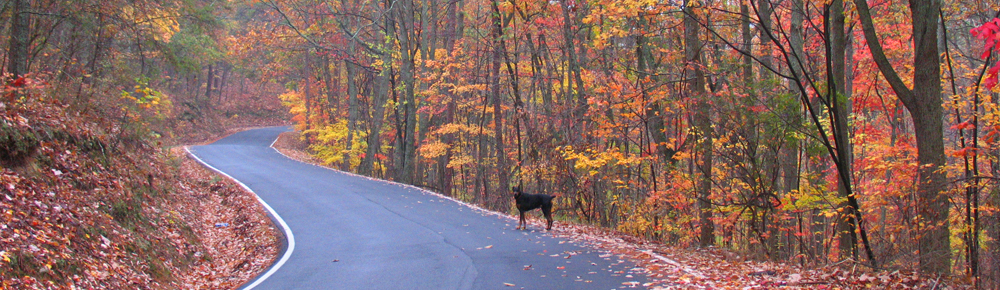
Dead leaves fill the ditch on the uphill side of Fouche Gap Road where I walk the dogs, and Zeke almost invariably ends up running through the leaves like this:


What I really wanted to get was when he rolls in the leaves like this:

I took both of these videos with my iPhone. The last one has the classic amateur photographer’s shadow in the picture. Zeke has taken his leaf bath for a lot longer than he does in this clip, but I never seem to be able to get my phone out and videoing in time to capture it.

Lucy never wants to play in the leaves. I think she is mainly interested in getting the darned walk over so she can run into the living room and jump into her bed. I need to try to get a video of that, but I’ll have to be quicker than I have been with Zeke.

We also have cats, but I have never noticed any similarity between the behavior of cats and kids. Leah, who is much more familiar with cat behavior, says she has never thought about whether cats and kids act alike. I’m trying to picture kids bringing a dead mouse to the back door. I can do it, but just barely.

Gardenia memories

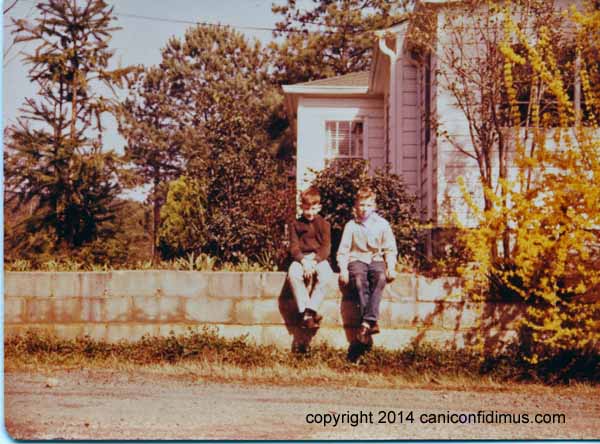
I scanned a lot of old pictures a few years ago to put on a digital picture frame for my mother. I was going through some of them Friday and found this one, which shows my brother Henry and me (I’m the one on the left) and, coincidentally, the gardenia I mentioned in an earlier post. The gardenia is right behind us. It looks like it’s at least six feet tall.

Mark, Henry, Gardenia

Mark, Henry, Gardenia

From more than a half a century away, these seem like pictures of someone else. I remember a lot of things from those days, but even the memories seem to be someone else’s. I was probably around seven here, so my brother was around 10. My parents would have been in their 30’s. Today I think of people that age as kids.

When I see pictures like these, I don’t see me and my family at that age, I see the entire history of the Paris family, from the young mother and father with two little boys to the aged parents who die and leave two old men behind. I see all the big events that shaped their lives, and, as you probably know, bad things seem to leave stronger memories than good things. It’s like watching a movie you’ve seen many times before, so you know what’s going to happen next. You want to call out to the characters, “No! Don’t do it!” But, of course, you can’t. It’s all going to happen again, the good and the bad, played out in my memory.

Memory is like a scolding parent trying to keep you from getting into trouble. It’s not there to make you happy, it’s there to keep you from touching that hot stove again. So looking at the old pictures I scanned is a melancholic experience. It takes an effort of will to shut up the nagging part of the brain. Yes, yes, I know, the parents die in the end, but in the meantime, let us have some fun, for dog’s sake.

The cold and the deer

When I was a little boy, there was a gardenia right outside our kitchen window. Since we didn’t have air conditioning, in warm weather we opened the window while we ate. When the gardenia was in bloom, its strong smell drifted into the house. I think it was probably about six feet tall, but that was a long time ago, and I was small so it might not have been that tall. Fairly frequently in those days we had winters cold enough to kill it back to the ground.

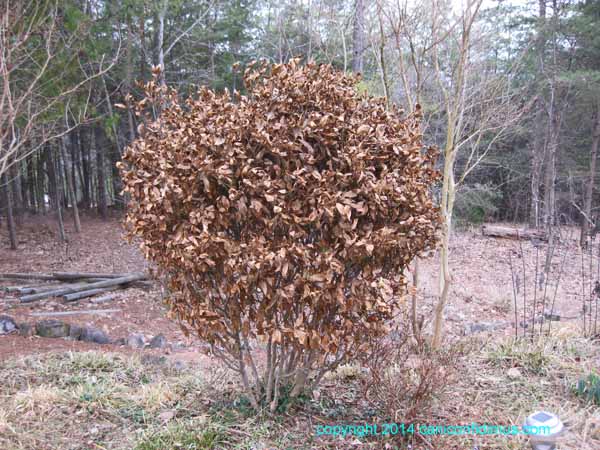
When we were looking for plants for our house, Leah and I chose some gardenias. We planted two dwarf and one variegated gardenia right beside the driveway in what we call our island. The dwarf gardenias have grown well and usually have a lot of flowers. The variegated gardenia was grown reasonably well, but has only had a handful of blooms. We like it mainly for its green and yellow leaves. The gardenias have been there for nearly nine years, and never suffered any cold damage, or at least none to speak of, but this winter has been different. The variegated gardenia is completely brown.

Variegated gardenia

Variegated gardenia. The leaves should be yellow and green

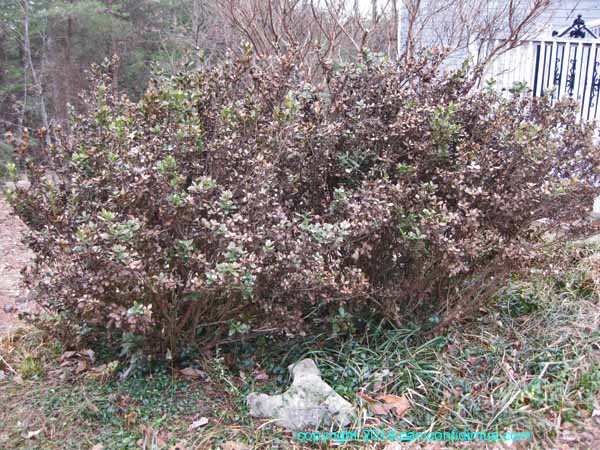
The dwarf gardenias suffered less cold damage, but they are pretty ugly right now.

Dwarf gardenias, pruned back

Dwarf gardenias, pruned back

I pruned back some of the worst parts of the dwarf gardenias, but I was afraid to cut any of the variegated variety. I think the dwarf gardenias will come back OK, but I’m not sure at all about the variegated gardenia. Its branches are still green, but it has no foliage at all now. If it doesn’t sprout new leaves this spring, I may have to cut it back drastically, assuming it even survives.

I don’t know exactly what our lowest temperature has been this winter, but it has been at least in the lower teens or upper single digits. Rome’s official lowest temperature for this winter was 0F.

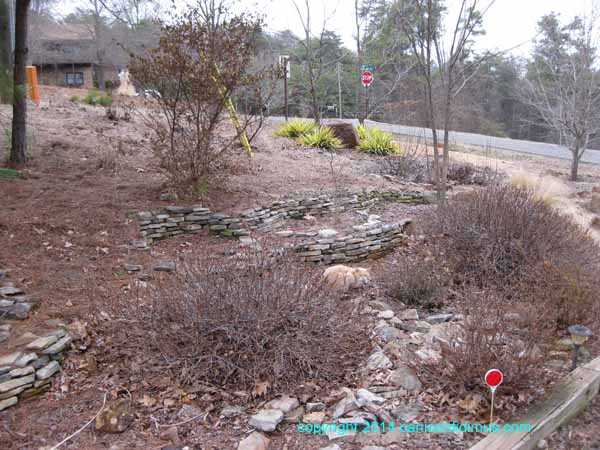
Some of our plants didn’t have enough foliage to worry about cold damage. The deer made sure of that. These plants (I don’t remember what the one in the foreground is, but there is a variegated privet bush behind it, and one more like it behind that, as well as a couple of puny azaleas) are evergreens and a couple of months ago were entirely covered with green foliage. The deer have stripped all of them.

deerfood

The taller shrub in the left center background is a loropetalum. It is essentially all brown now, as are two large loropetalums at the side of the house. The deer apparently don’t like loropetalum.

I have seen the culprits several time around the house and in our neighbors’ yards. Zeke has noticed them, too. I imagine that if Zeke lived outside, he would have kept the deer away.

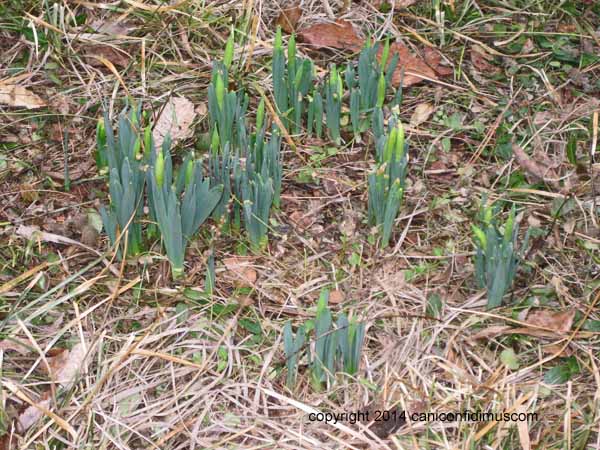
So with cold and deer, most of our shrubs are in a pretty pitiful state. At least the daffodils will be blooming soon.

daffodils

The crocuses have already bloomed, so at least we’ll have some color other than brown for the last month of winter.

crocus