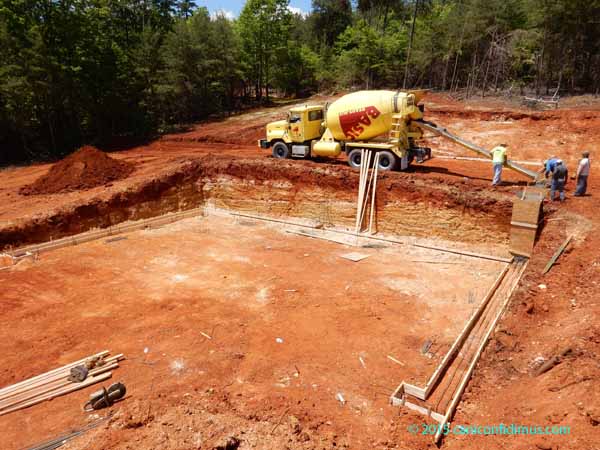
The foundation crew put up forms for our poured foundation walls on Tuesday, May 12. Leah and I walked up to look Tuesday evening. Standing inside the basement-to-be, Leah thought the house looked small, but that’s normal. In my experience, a house under construction goes through stages when it looks too small or too large before it finally looks like exactly the size it is.
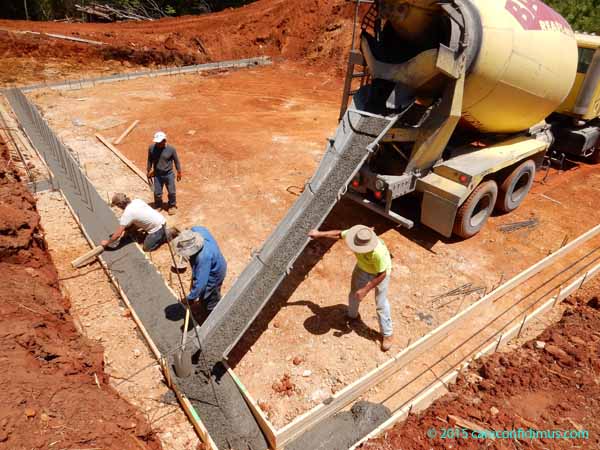
Late Wednesday afternoon, after the building inspector gave his OK, the concrete was poured. When I walked up to the lot around 2:30, the crew said the first concrete truck was expected around three. The pump truck was already there, idling in the middle of what will one day be our basement.
Three came and went, as did four. A little after four pm, the crew boss arrived and said the first concrete truck had overheated and had to stop at the base of the mountain, and then, after cooling for a while, overheated again about halfway up.
Every hour the pump truck was in transit or on site, even while idle, costed around $135.
It was nearly 5 pm before the first concrete truck finally arrived. The crew didn’t waste any time getting started.
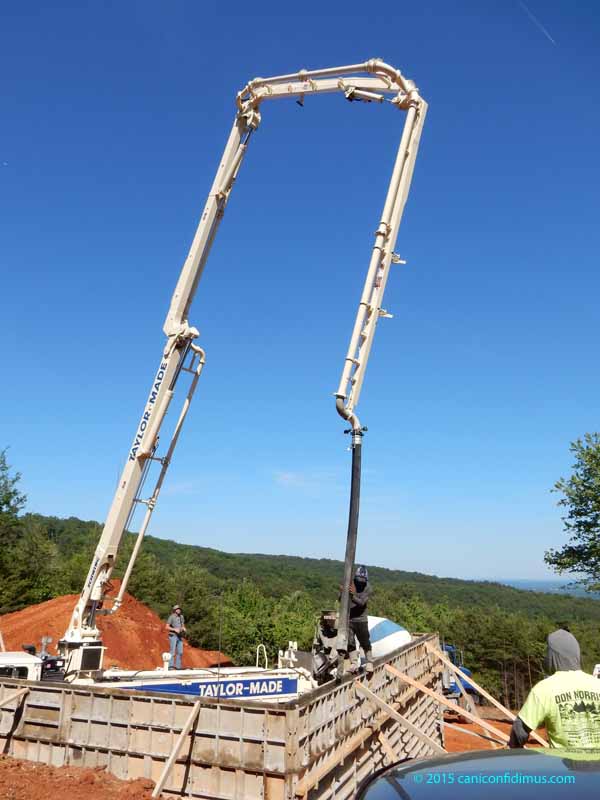
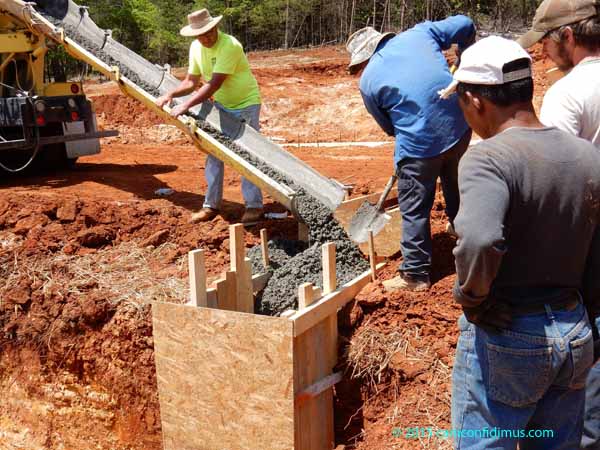
In case anyone is not familiar with how these things work, the concrete truck (with the blue stripe), dumps its mix into a hopper (right behind the “TAYLOR-MADE’ logo on the pump truck). A pump then sends the concrete up the long boom and out the heavy flexible hose the worker is holding over the form.
Concrete has to be agitated in these 10-foot-deep forms to make sure there are no voids. The crew used a electric, flexible, vibrating rod powered by a generator. The motor is on the end to the right, and the business end is on the left.
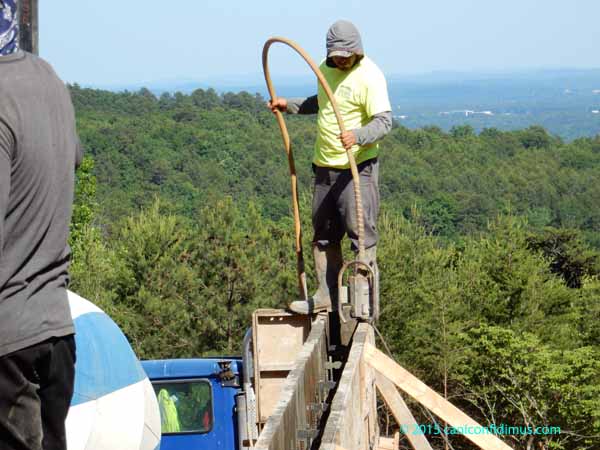 He dips it deep into the concrete and it does its thing.
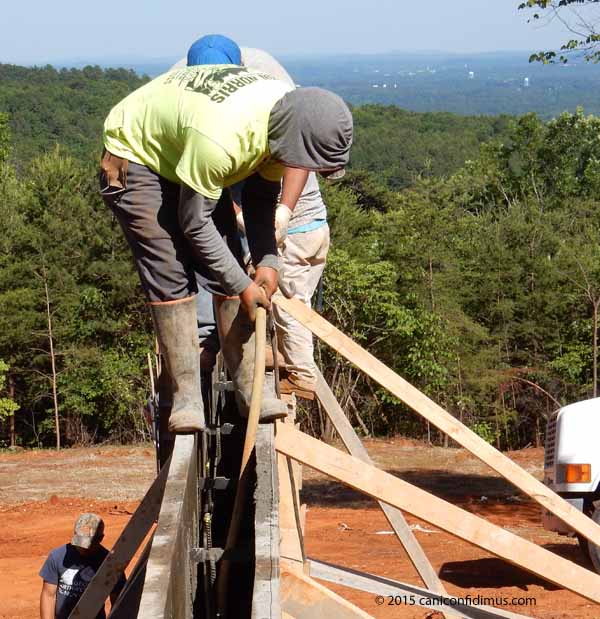
I took some more documentary pictures, but I was ready to leave after about 45 more minutes. As long as I move, my back is fine, but if I stand around for any length of time, it starts to hurt. Standing for more than two hours was enough, so I told the crew boss I was going home. Besides, Leah had put beer in the freezer so we could have a really cold one, and I was ready for that.
Here’s a shot as I left. The boom operator has the boom controls hanging at his waist so he can stand where he can see what’s going on.
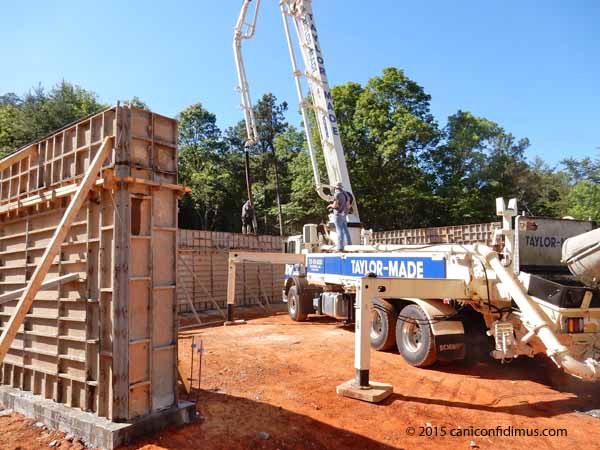 Pump trucks are a life-saver for concrete pours. Without one, a concrete foundation like ours would be impractical for a typical homeowner.
The third of five trucks was waiting for me at the bottom of our driveway when I left. Leah and I were at home when we saw the last piece of equipment turn around at Wildlife Trail at around 6 pm.
The crew will come back Thursday (today) to remove the forms. Pretty soon after that, I hope, another crew will come to waterproof the foundation. Based on the estimate, the material alone would account for half the cost, and I’m not sure how easily I could get the right materials. So that’s one job I had intended to do, but won’t.
While I was waiting for the pour to start, an engineer from Georgia Power came by to talk about temporary power. I have to get someone to dig a trench for the underground service up to the temporary service post, and I have to get an electrician to get the inspection and provide some of the equipment. We’re setting the date for that around the end of the month, but I hope to get it done sooner.
Concurrent with that, I need to get a plumber to put in the drain pipe that goes below the basement slab and out to the septic system. That has to be done before the basement slab is poured, and the slab has to be poured before framing can start.
Framing is the biggest part of making a house under construction look like an actual house, so we’re looking forward to that.