An old B-E at work

The well driller showed up on Monday, June 29. I heard the rig so I went up to the lot and looked. Here it is at work.

This is a Bucyrus-Erie cable drilling rig. It’s nearly as old as I am, and it’s in operation in this video by the fourth generation in a well-drilling family. According to the young fellow working the rig, it belonged to the grandfather of the current owner, who passed it to his son, who passed it to his son. Now the young fellow, who married the owner’s step-daughter, is using it. He said it dates to 1955, although the truck it’s mounted on probably dates to around 1970.

Cable drilling rigs are obsolescent, if not obsolete. They have been largely replaced by rotary drilling rigs, which, according to what I have read, drill holes significantly faster than the brute-strength method of a cable rig. The cable rig raises a heavy steel pipe with a bit on the end and drops it repeatedly. There is no rotation of the bit, so the bit drives through the earth and rock simply by pulverizing it.

In the last part of the video, you can see another steel pipe resting at an angle in a larger metal pipe. The operator periodically pulls the drilling bit out and drops the other pipe in. There is a trip mechanism at the end of the other pipe which opens the end when it reaches the bottom of the hole, so it lets the slurry into the hollow pipe. Then, as it’s raised, the trip mechanism closes the valve and the operator brings it up to dump the slurry. It runs out through the open end of the larger section of pipe and then down the hill. Then the operator drops the drilling pipe back in, puts some fresh water in, and begins drilling again.

This is some of the slurry from early in the drilling process. It’s lighter and not as red as the overlying soil. That means it came from the upper layer of sandstone, which varies in color from white to brown to reddish. This slurry was gritty from the pulverized sandstone.
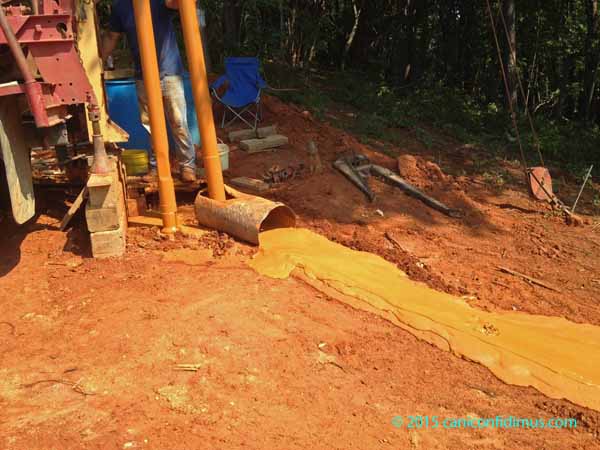
slurry

Later on the slurry was darker. The operator said that came from a layer of dirt beneath the upper rock layer. And then after that, there was some lighter slurry with a mixture of larger rock pieces, which came from a lower, harder rock layer that didn’t turn into sand when the bit pulverized it.

This type of rig is based on a drilling rig patented back in the mid-1860’s. Bucyrus-Erie bought the rights to it some decades later. The rigs were used not only to drill water wells, but also to drill oil wells, back when oil well depths were measured in just a couple of thousand feet.

Bucyrus-Erie apparently sold its cable rig manufacturing to another company which continues to offer parts for old rigs like this one.

Petroleumhistory.org has an informative description of cable drilling rigs as well as information about Bucyrus-Erie. I would say it’s interesting, but that’s probably a matter of opinion.

This old rig is slowly drilling its way into the earth. As of Wednesday, I can still open the door and hear the rig working down the street at our new house site. The same rig was used to extend our neighbor’s well to 450 feet after they had some well problems. Our current well is less than 300 feet deep, but we have never had any hint of supply problems, even back a few summers ago when we had a fairly severe drought. I don’t know how deep the new well will go, but we will probably be conservative about it, which means deep.
Fox and armadillo

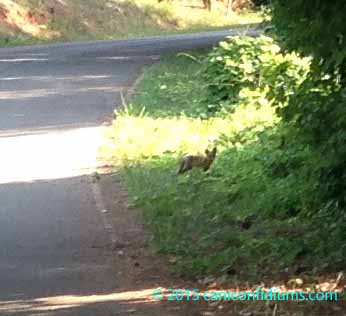
I have mentioned before that we have foxes around the neighborhood, some of which regularly visit our driveway to poop and eat catfood*. I recently saw more of the family. This was about halfway down Lavender Trail from our house to the driveway of our new property.

fox kit 2

This fox kit watched me and the dogs approach for a while, but dived into the brush before we got close. The image is fuzzy because I took it with my phone from a good distance, and the phone camera has a wide angle lens. The scale is not obvious here, but the kit is quite small. I think it would fit into two hands cupped together, with maybe a little overflow.

About two weeks ago I saw two fox kits. This time I saw only one. I’m pretty sure the den is somewhere in a thick patch of kudzu that grows beside the road. There is an obvious path through the kudzu leading into the darkness beneath the growth.

On Monday morning as I walked the dogs I looked into the path and saw this.

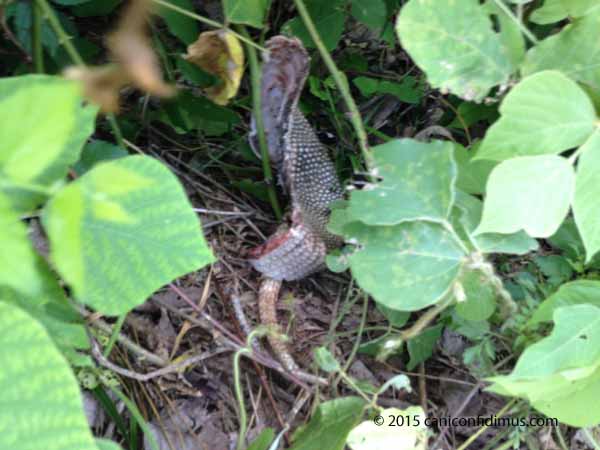
armadillo skin

It’s the skin and the tail of an armadillo. The picture is fuzzy not because of distance but because I was holding the phone at arm’s length and wasn’t as steady as I might have been. It was also dark down there.

It was gone when Leah and I walked the dogs Monday evening.

I assume that the mother fox brought it either to feed one or more kits or to eat at her leisure. I don’t know how the fox came to have the armadillo. I would have thought an adult armadillo would be too large to be fox prey. Maybe the fox found one killed by a car, or maybe it found the remains of one that a coyote had killed.

* Edited to clarify exactly what the fox eats. Thanks, Scott.

Longleaf mohawk

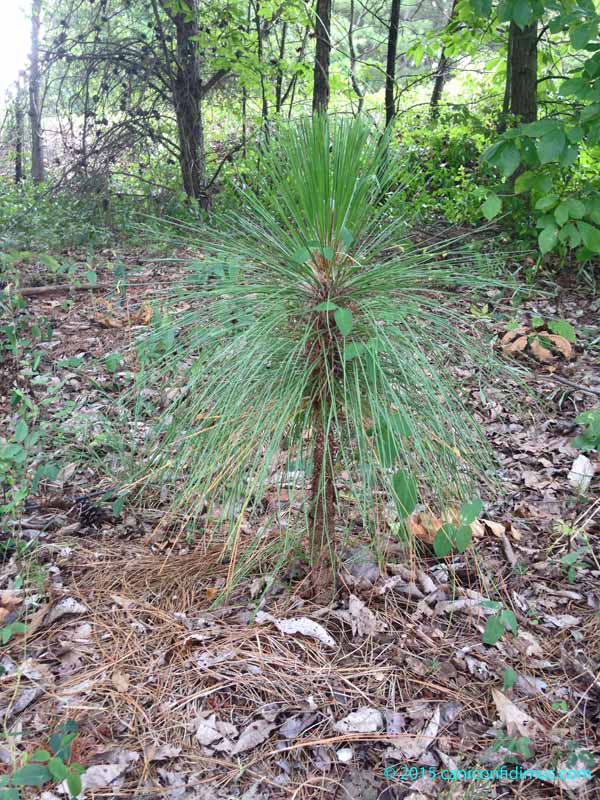
The longleaf pine I transplanted a few years ago continues to seem healthy. I mentioned earlier that it seemed to be entering the bottlebrush stage, leaving the very young grass stage behind. It’s definite now.

longleaf mohawk

There’s a little wild pea plant growing up into the needles.

Earlier in the spring I noticed a bunch of needles sprouting from the center and growing upwards. It looked like a mohawk haircut. It seemed like they were growing noticeably day by day. Their growth seems to have slowed with our dry weather, but the plant looks healthy overall. It’s very encouraging.

Not too long from now, however, we will move from our current house and I will no longer be able to tend this little longleaf. I plan to tell the new owners about this young tree and a little about the history of the longleaf pine in this area (if they aren’t already familiar), and then encourage them to preserve this one.

In the donut hole

We have been in a very dry period up here on the mountain for the last few weeks. We’ve had one rain event of nearly a half an inch, and a couple of drizzles that gave us about 0.02 inches each.

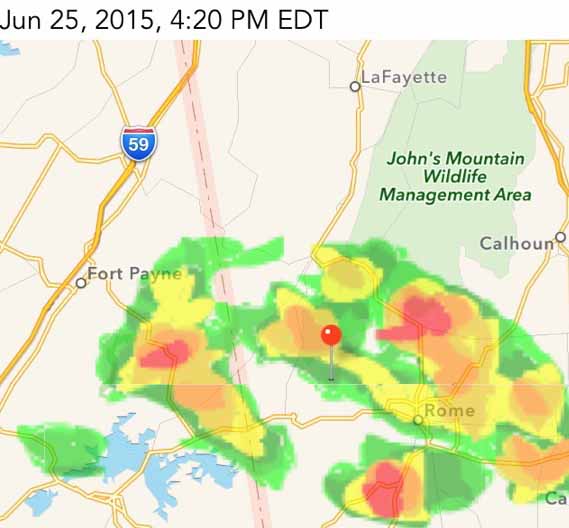
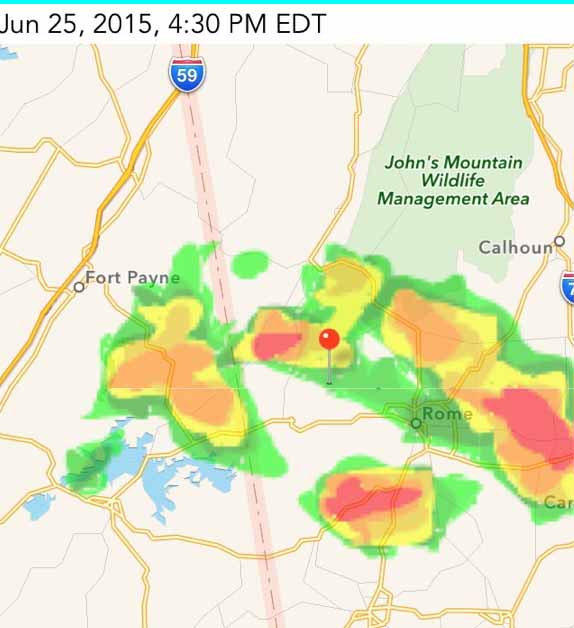
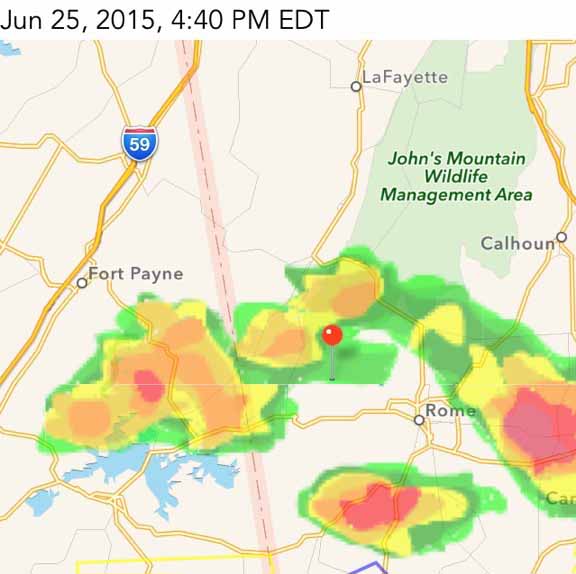
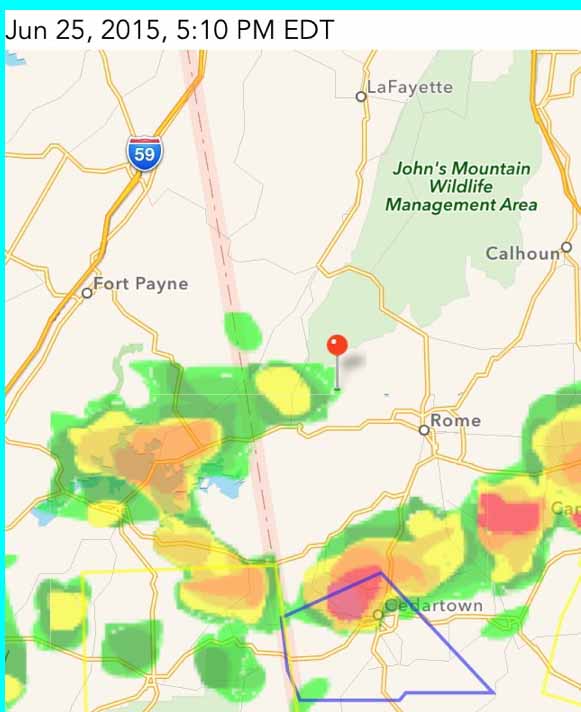
It’s not that there has been no rain anywhere in northwest Georgia, it just seems that it keeps missing us. On Thursday when I met the well driller up at the new house, there were dark clouds and thunder. The well man wasn’t sure he wanted to erect the drill rig because of the lightning. Here’s the sequence on my phone’s weather radar app as I watched the rain fall all around us.

june25radar4_20

june25_4_30

june25_4_40

june25_5_10


We got just enough actual precipitation to get the new garage slab wet, but not enough to wet the dust in the yard.

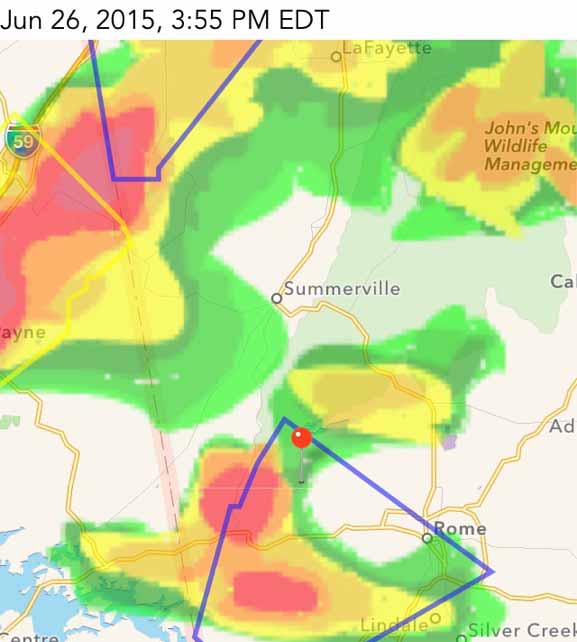
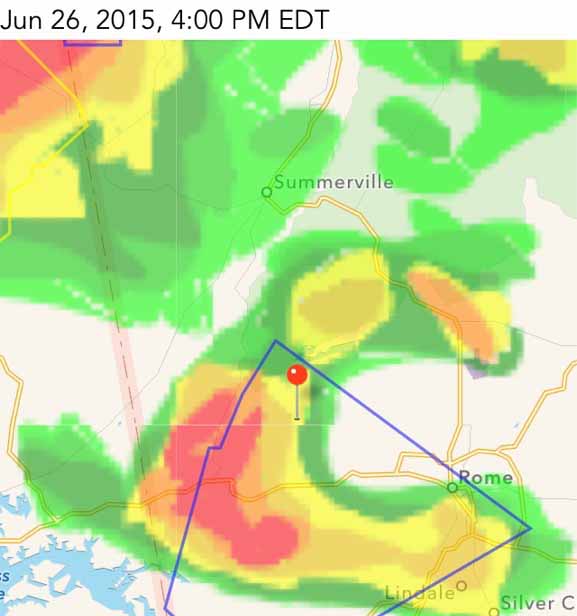
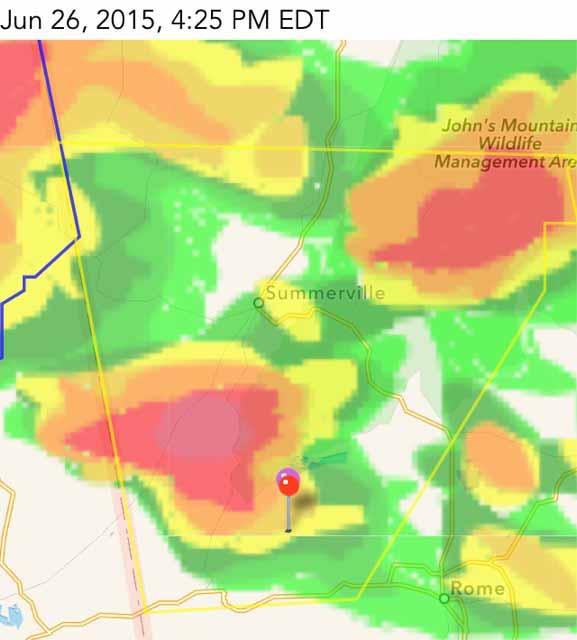
Friday we had a severe thunderstorm warning. It looked bad enough that I wasn’t sure I wanted Leah to drive down the mountain on an errand. I shouldn’t have worried. Here’s that sequence.

june26_3_55

june26_4_00

june26_4_25It looks like we were on the edge of the heaviest rain, but the total as of 7:45 pm was 0.02 inches.

I’m glad there has been rain around us. I assume that rain around us refills the aquifer we rely on, although I have no actual knowledge of hydrology. That’s good, since it means our well probably won’t run dry, but it doesn’t help all the plants that need water.


House update, June 24

We had the basement and garage slabs poured for the new house on Monday, June 22. This is the final step required before framing can begin.

At 7:30 that morning we heard the concrete trucks turning around just outside the house on Wildlife Trail so they could aim directly up the drive instead of having to make a sharp right-hand turn coming up from Fouche Gap Road. I walked and fed the dogs, grabbed a quick bowl of cereal and then went up to see things. David and his two helpers were about halfway through the basement pour.

slabpour1

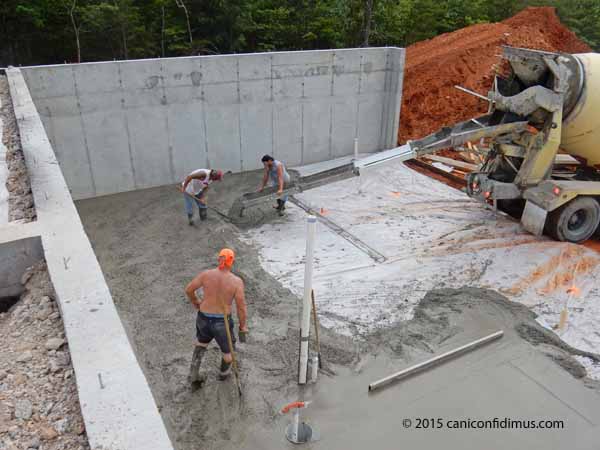
In this shot you can see several significant things. First, of course, the truck is dumping concrete down the chute while one worker directs the pour and the second spreads it. The gravel base is covered with plastic. David (wearing the orange head wrap) is standing close to a screed, the long piece of metal that looks like a 2X4. Just behind the man holding the concrete chute is a depression in the gravel with two pieces of rebar (reinforcing bar), which is used to strengthen the concrete so it can support a load-bearing wall. In the foreground you can see that a cut-off plastic bucket has been placed around one of the plastic plumbing stubs. That is where a shower or tub drain can go if we ever decided to put a bathroom in the basement. The bucket allows some adjustment of the placement of the pipe if necessary. You can’t see a large metal tub that was placed around the potential future toilet flange because the flange was installed slightly too shallow. That will allow the flange to be cut off and reinstalled at the right height. The area that has no concrete because of the bucket and the tub can be filled later with concrete mix from a sack.

The two other plumbing pipes in the foreground are a main stack (draining the two bathrooms) and a shorter stub that can drain a basement bathroom sink. There is a second stub against the far wall to drain the kitchen fixtures.

What you can’t see is that the main stack and the basement sink drain are almost two feet off in placement. That happened because the plumber got his locations by measuring directly off the floor plan, which indicates that the scale is ¼ inch to the foot. Unfortunately, the floor plans did not print out at that scale, so the pipes ended up in the wrong place. It’s a glitch, but one that can be worked around. Obviously, all future measurements have to be taken directly from the plan dimensions rather than by using a ruler and scaling a foot to each quarter of an inch.

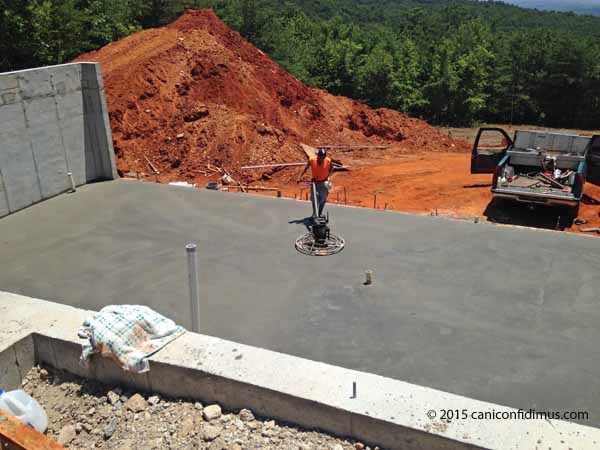
Here one of David’s workers is using a powered concrete trowel to finish the basement floor.

slab pour2

I didn’t stay around to watch all the pour or finishing work; it was too hot. I don’t know how David and his helpers did it. It was in the 90’s before noon, and they were working in full sunlight the whole time. And they’re all old guys (probably not as old as me, but I’m not doing concrete work). But they did it.

Our next step is finding a framer. I should have settled this weeks ago, but no. I have found three potential framers. One has given an estimate. The second, who did neighbor John’s house, picked up a set of plans Thursday and will, I hope, give us an estimate by the weekend. A third promised an estimate by Wednesday, but I haven’t received it yet.

My lack of foresight is probably going to cost us nearly a month’s delay in starting framing. I hope I can get some other work done in that time, including the well and the septic system.