We took this picture about a month and a half ago not long after Sylvester got his summer cut.
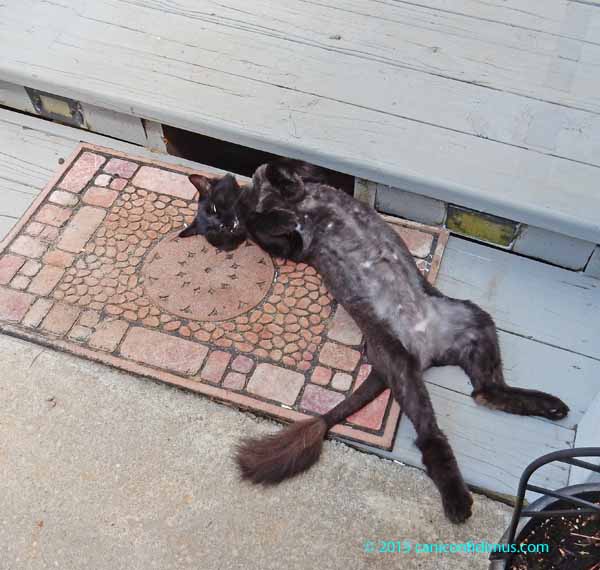
It must have been a hot day.
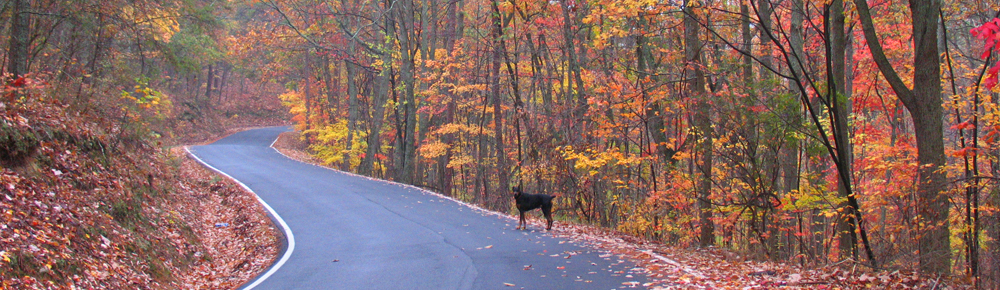
We took this picture about a month and a half ago not long after Sylvester got his summer cut.
It must have been a hot day.
We haven’t seen many turtles lately, but within the last week we (or I) saw two on Fouche Gap Road. The first one was immobile but apparently trying to cross the road near the bottom of the mountain.
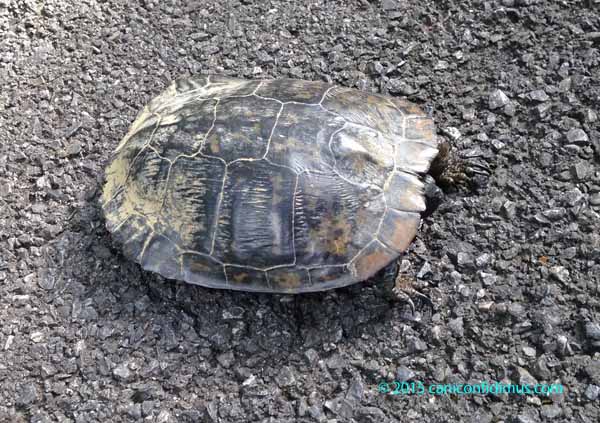
We stopped so that I could move it out of the road. At first, from a distance, I thought it was a snapping turtle because it seemed to have such a flat back. Up closer I realized it wasn’t a snapper. It was a full hand-span wide. I put it at the closer side of the road, but Leah and I both worried that it was going to head back out into the road after we left. Fortunately, there was no sign of it when we came back home.
Monday morning Zeke found another turtle closer to the top of the mountain.
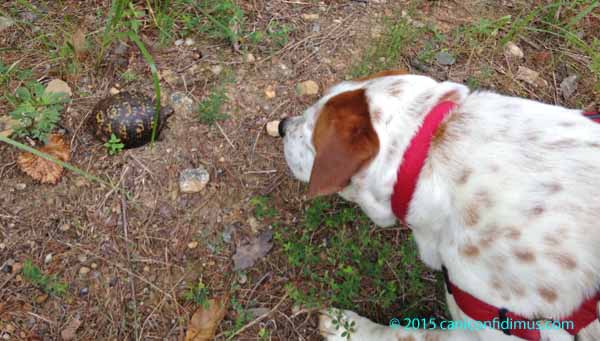 Zeke is a good turtle hound.
This one was safely in the weeds, so I didn’t bother him/her. Here’s a closer shot.
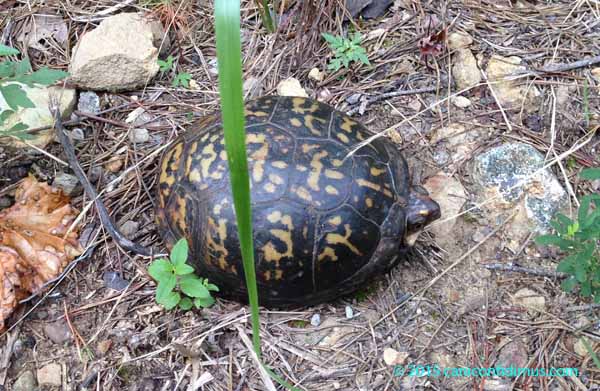
Maybe two turtles doesn’t qualify as “turtles all the way down” but two within a few days is a lot for up here.
When I took the dogs outside for their morning walk around the house Monday, the sky was completely covered by waves.
 It was like this from horizon to horizon. It was impossible to get the entire sky in the picture. I tried a panorama, but that didn’t work. By the time I took the dogs out for their long walk, the sky was almost entirely clear.
Everyone knows there’s a Web site devoted to every possible subject. I learned a few days ago that there’s one devoted to old barber shops when the owner contacted me asking for permission to use some of the photos from my post about the Forrest Barber Shop. Of course I was happy to give him permission to use it, and he did. The site is an interesting glimpse into an old, nearly forgotten world.
We have quite a lot of sumac shrubs around the mountain. There are several fairly large shrubs behind the house. They must be a bee’s dream, because every summer when the sumac blooms the bees swarm around them. I walk by one every time I take the dogs around the house. This is what it looked like a few days ago.
It seemed to have at least one of every kind of bee.
Our sumac produces creamy white flowers. There are some down on Huffaker Road that produce deep red flowers. One of our neighbors thinks sumac is poisonous, but this variety is not. The Wikiepedia article says that varieties with white drupes (fruit) are poisonous. I routinely pull small shoots out of the ground with my bare hands and have never had the kind of skin reaction that its relative poison ivy causes. According to that article, “true” Rhus species have red fruit. I don’t recall actually seeing red drupes on our sumac, but Leah assures me that’s what color they are. I’ll have to pay more attention later this year.
The major drawback of sumac in my view is that it spreads vigorously along its root system. If you cut one large sumac, its children continue to develop for years from the root system. That makes it hard to control. The Wikipedia article suggests goats as a control method. I doubt we’ll resort to that.