Fantastic Ms Fox

Saturday night Zeke and the fox met. I heard Zeke barking out on the front walk, so I went out to investigate. The fox was in the driveway eating cat food. I shouted at the fox (I’m assuming it’s a female), but she ignored me. So I opened the gate to chase her away. The fox still ignored me. Before I could do anything Zeke pushed out around me and took off after the fox. This the fox did not ignore. The fox ran down the drive and into the woods with Zeke not far behind. As the fox ran across the road it seemed to get a little more distance between her and Zeke. There was absolutely no point in trying to do anything, so I went back inside. I told Leah that if the fox was not faster than Zeke, Zeke was going to catch it and kill it.

I pictured two possible outcomes. One, Zeke would end up a couple of miles away on the road at the base of the mountain, covered in mud and with his tongue hanging out. The other was that I would find him in the woods with his face covered in blood. I went into the woods down in the direction they had run, which is in the general area where I think the fox couple may have had a den in the past. I stood and listened for a while, but heard nothing. I called Zeke and clapped my hands. Still nothing.

So I turned around to go back home. As I got to the entrance to the driveway, I saw the fox right back where it started, looking for more cat food. Zeke was nowhere to be seen. The fox ran away from me, but in more of a trot than a gallop. I think it knows about my bad knees. A little while later when I took Lucy out for a short walk, I saw Zeke in a neighbor’s yard. He seemed a little abashed.

So I was wrong about the outcome of the chase. I had only considered that the fox would be either faster than Zeke, and thus escape, or be slower than him, and thus be eaten. I left out the possibility that Zeke might just be outfoxed.

Not a professor

Perhaps not as smart as he looks

Foxtrot

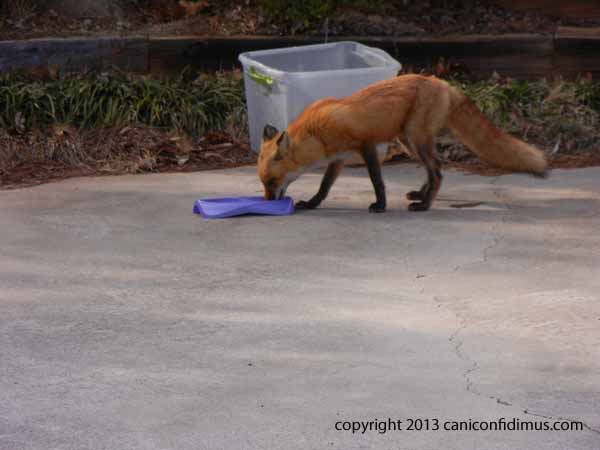
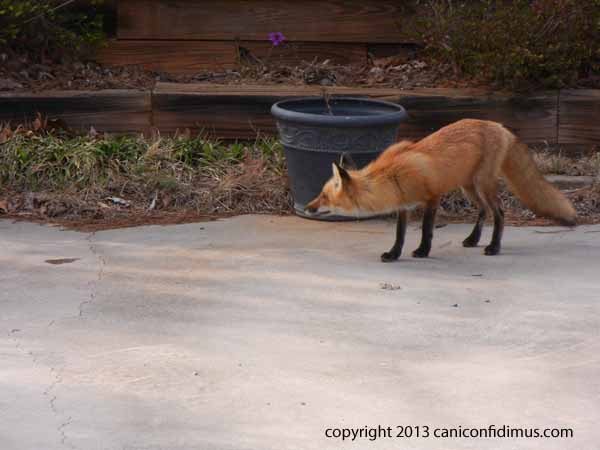
The fox we wrote about on Sunday came back on Monday. This time it was early enough in the afternoon that I was able to get some better shots. I was also able to catch it doing what we thought it was doing.

Scarfing down the cat food

Scarfing down the cat food

He came to the cat food bowl and started eating enthusiastically, despite Zeke’s constant barking. And Zeke’s bark is loud. He (she?) ignored me as long as I stood behind the gate on our front walkway.

Look carefully on the pavement just behind the fox’s back legs, under its tail. The concrete is wet. I have noticed wet spots on the driveway after the fox visits before. It appears that the fox is urinating. I wonder if this is normal behavior.

It also poops occasionally near the food. The poop contains hair or fur. This indicates to me that it is getting at least some of its diet from its normal prey.

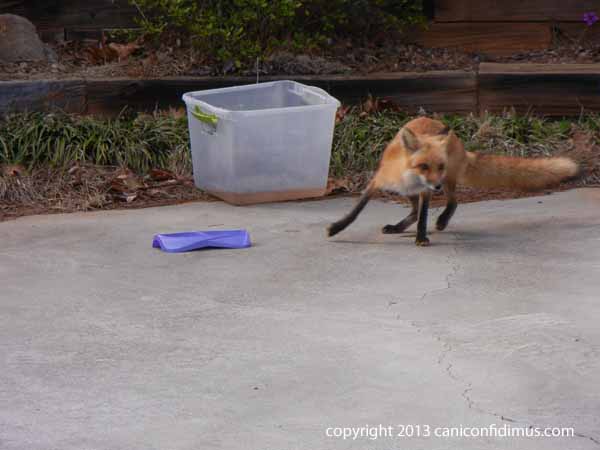
Retreating quickly

Retreating quickly

He didn’t leave until it was obvious that I was going to approach him, and then he retreated. But not far.

Waiting to see

Waiting to see

I picked up the cat food bowl and went back to the front walkway. He waited a few minutes, then came back. It’s our little dance. I come out, he watches. I approach, he retreats. I retreat, he comes back.

Where did it go?

Where did it go?

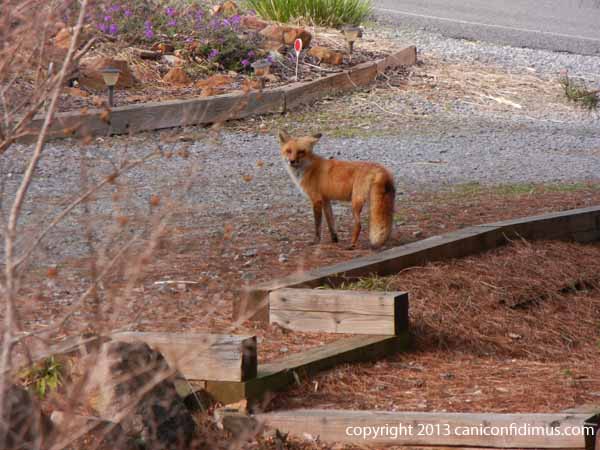
He checked out where the food had been, and then walked away.

Leah and I have a strong inclination to feed this fox, but we both know better. And, based on his (her) poop, he is getting at least a few mice.

The fox and the pussycats

I have written about the fox before. Now I’m beginning to think we have two. It makes sense that there would be a pair, since we have seen fox kits up here. The two, if there are two, seem to look somewhat different, and they seem to behave differently. One seems to be indifferent to us and the dogs, as long as we don’t come too close. But recently we have seen a fox disappearing into the woods at a dead run.  I’m used to having to actually approach the fox to make it retreat, and then it just trots away and turns around to see whether I will come any closer. It seems that the shy fox is a little lighter in color, but it’s hard to tell because we have only had a fleeting glance, and that from the rear.

Saturday night a fox made its regular appearance at the usual time. It was just after sundown, around 8 pm EDT. It was light enough to see but too dark to get a decent photograph without putting the camera on a stable platform.

The three original travelers and the fox

The three original travelers and the fox

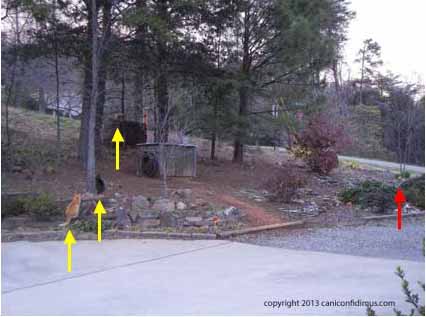
Here the three original castaway cats (yellow arrows) watch the fox (red arrow), who is trying to hide behind a bush. The cats are Chloe and her two children, Rusty (up front) and Dusty, who is perched on a big rock. The fox was watching me and Leah and paying only a little attention to the cats. The cats had been further away, but they came out a little closer, apparently to investigate. They were not afraid. In fact, Rusty was more interested in jumping on Chloe than in watching the fox.

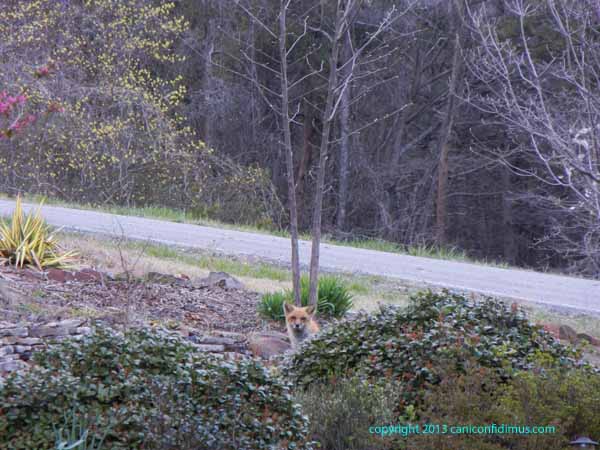
Watchful but not particularly afraid

Watchful but not particularly afraid

This was taken with the longest telephoto setting on our little point-and-shoot Nikon. I had to rest it on the deck railing and the exposure was long enough that even slight motion by the fox blurred the image. The fox was probably around 50 or 60 feet away.

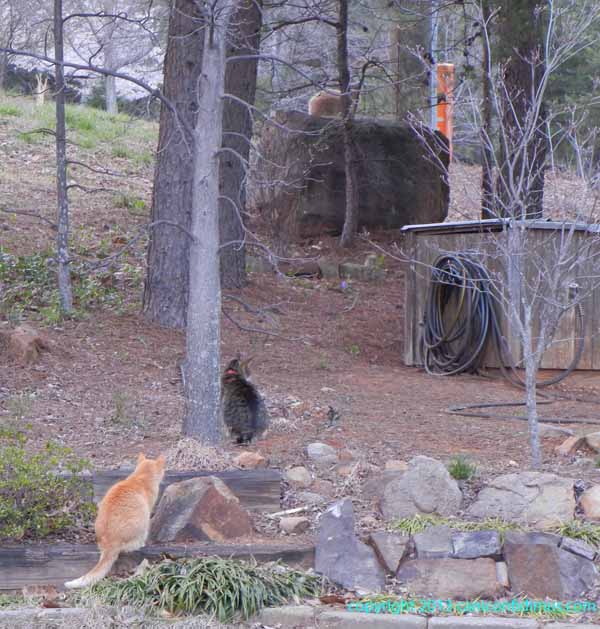
Rusty, Chloe and Dusty, semi-interested in the fox

Rusty, Chloe and Dusty, semi-interested in the fox

Chloe, the dark cat, was watching the fox, while Rusty, up front, was watching Chloe. After a few moments Rusty pounced on Chloe. Dusty was too far away to tell what he was interested in.

This event was a little confusing, because this fox’s coat looked like the lighter, shy fox’s. I haven’t seen both foxes (if there really are two) together, so it’s hard to tell. But this one acted the way I’m used to. When I tried to get closer, he retreated, but slowly and not far. He stayed at the end of the driveway and waited for me to go back inside. Then he came in close to where Rusty and Chloe had been sitting, which is where Leah usually puts their food.

We have been noticing that the cat trays we leave in the garage are usually licked clean by morning, which is not normal for the cats. Possums and raccoons do that, but whatever is doing it is not tempted by peanut butter crackers, which we have been using to bait a live-capture trap. Peanut butter crackers have always been a sure bet to catch possums and raccoons, so we are pretty sure that it isn’t either of them. We know for sure that one of the neighbor’s dogs came into the garage for the buffet at least once, but that dog does not normally roam free. So we think something else is eating the catfood, and it’s probably a fox.

There is no sign so far that the foxes consider the cats to be food.

The one resident up here who is not indifferent is Zeke. He desperately wants to meet the fox. Last weekend when I took him and Lucy for their last walk of the evening, we saw a fox run away from the front of the garage. I was holding the dogs’ retractable leashes in one hand. When Zeke saw the fox, he took off, jerking the leash out of my hand. It also jerked Lucy’s leash out of my hand, and unfortunately, it was tangled with Zeke’s. Lucy’s leash happened to be on the opposite side of a post I was standing next to. When Zeke ran away, it pulled Lucy back towards me and the post. I had no idea what was happening, and neither did Lucy. Fortunately Lucy’s collar came off, so after she bounced around next to me, she ran off towards the front door as Zeke disappeared into the night, trailing both of their leashes.

There was no point in trying to find Zeke, in the dark and rain, so I went in to make sure Lucy was OK. She was. A couple of hours later Leah went out and heard Zeke barking. I took an umbrella and a flashlight and followed the barking to him. He had wrapped his leash around two trees and was stuck with about two feet of slack. I rescued him and took him back inside. The fox, whose eyes I could see in the flashlight beam, was about fifty feet away from Zeke. I think he was laughing.


Signs

There has been evidence of spring lately. Last Sunday afternoon it was definitive.

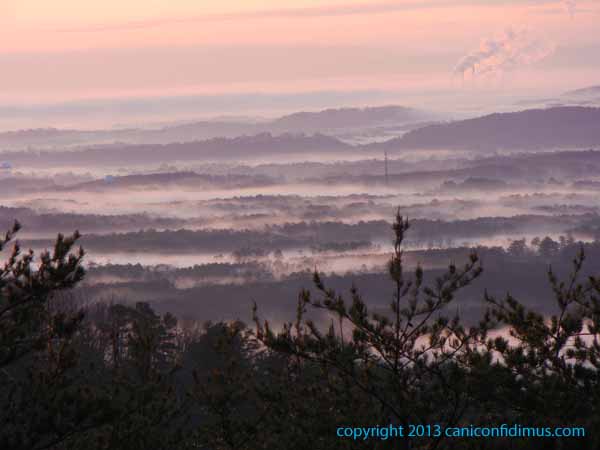
Banks of fog in the morning

Banks of fog in the morning

What you see here is drifts of fog in the low spots off to the east from the mountain at sunrise on Sunday morning, March 31. Saturday had been rainy, but during the night the clouds cleared and there was some nice radiative cooling. That cooled air settled in the low spots and the moisture in the humid air condensed. But that’s not a sign of spring; it’s common all year long. It’s what you don’t see here that is actually a definitive sign of astronomical or solar spring. The view off the deck towards town is due east, and the sun is coming up to the left, or north, in this view. On the first day of astronomical spring the sun rose due east, and since it’s too far north to be visible here, it is, by definition, spring, or at least past the vernal equinox. So at least in the solar sense that is proof, but spring comes at different times in different areas, and the location of the sunrise alone doesn’t mean spring is here on the mountain.

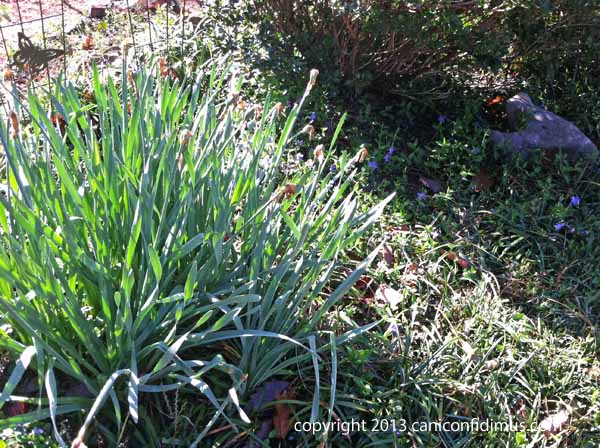
Faded daffodils and vinca

Faded daffodils and vinca

The daffodils have bloomed and faded. But daffodils can bloom early, and ours did. The vinca minor, or lesser periwinkle, in the background, blooms year-round. The blooms are more numerous in the spring, but they’re here all year long. So the daffodils and vinca don’t provide reliable evidence.

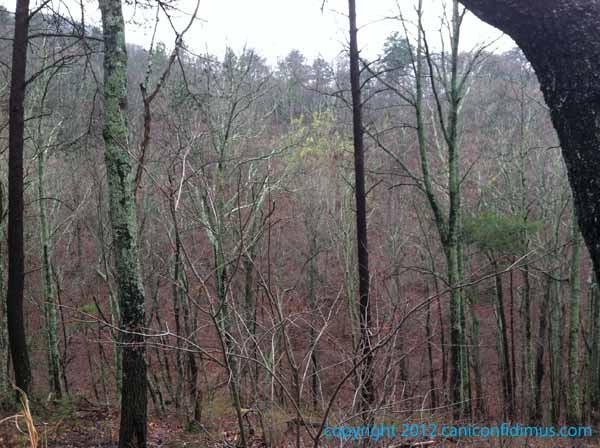
A hint of green on the mountain

A hint of green on the mountain

A few trees on the mountain are showing some green. We’re later up here than down in the lower elevations. It’s a sign, but not definitive.

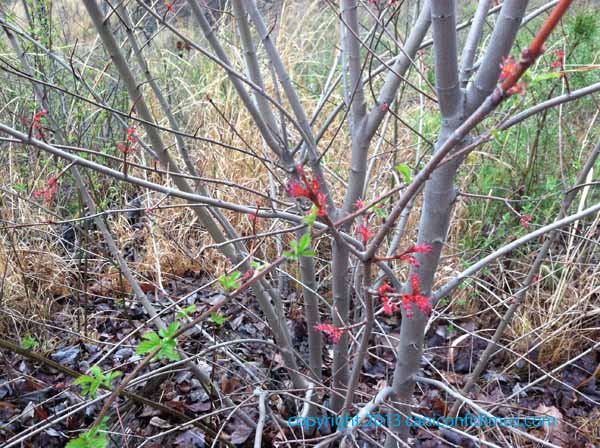
Blackberries greening and maples reddening

Blackberries greening and maples reddening

There’s green on the blackberry bushes and red on the maples.

Pine candles

Pine candles

The pines have brought out their candles but they haven’t been lit yet. I have seen, or rather felt, some pollen on the windshield, but nothing like the coat of gritty yellow we get later in the spring. But I have been seeing candles for a while. Not proof.

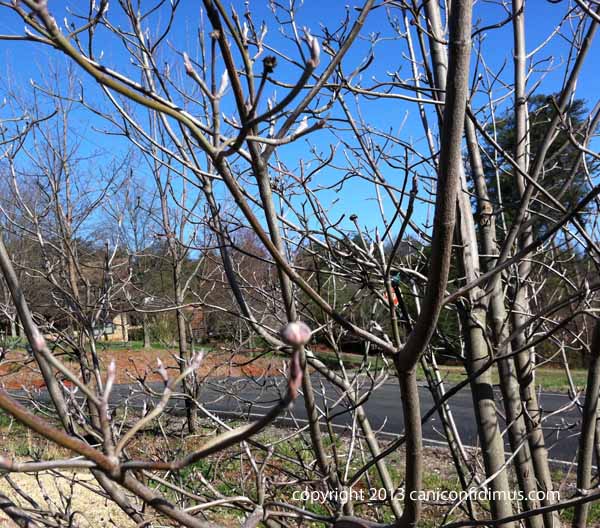
Dogwood buds

Dogwood buds

The buds have been on the dogwoods since last year, and they aren’t showing signs of opening yet.

I worked in the yard Saturday, and it was warm enough that I had to stop every few minutes to wipe sweat out of my eyes. But we can get 70-degree days in the dead of winter, so that’s not really a definitive sign.

No, the real sign that spring has arrived was something else that got into my eyes: bugs. The bugs were flying around my face, landing in my ears and committing suicide by diving into my eyes. They will pretty much disappear later as the weather gets really hot, but for the time being, they are a really annoying but pretty much definitive sign that spring is here.

Our baby’s becoming a bottlebrush

My father was born in Floyd County, up in northwest Georgia where we live now. He grew up here, and spent almost his entire life here. He roamed the fields and woods, and he learned to recognize and name most of the plants and animals of this area. He could name just about any bird from its call, and he knew the names of pretty much all the trees. In all the years I spent here, I never once heard him mention the longleaf pine (pinus palustris). We had pines in our back yard, but those were loblollies. There were some Virginia pines around, and a few white pines. The longleaf was completely unknown to me.

But back before the Europeans came to North America, the longleaf pine covered huge areas of the southeastern United Stages, stretching along the coast from Texas to Virginia, and from the coast to the foothills. There are several good sources of information about the longleaf, including one at Auburn University, and one right here next to us at Berry College. One source estimates that longleaf pine forests covered 140,000 square miles. That’s a lot of longleaf pines. Another source estimates that those forests now cover about three percent of the former range. Today, if anyone thinks about the longleaf, they usually think of it as a tree of the coastal plain. I imagine some people whose blogs I read have them around, like Florida Cracker. They may take them for granted. But not me. Not up here in the foothills, far from the coastal plains.

What made the longleaf disappear from so much of its range? Well, it was us, of course. Europeans. We used them for lumber, and we tapped them for turpentine. And when we reforested, we replaced them with faster-growing species like the loblolly. One perhaps unexpected problem for the longleaf was fire suppression. The longleaf is fire resistant, and in fact dependant on that to outcompete other trees and establish healthy stands. With periodic, fairly low-level fires sweeping through the longleaf forests, other types of trees were killed. The longleaf, in all its stages, was more able to withstand fires. So once we started suppressing all fires, both natural and man-made, one of the longleaf’s major advantages disappeared. Not too far over the border from us in Alabama there is a fairly large stand of longleaf pines at Fort McClellan. Military training there inadvertently maintained the longleaf ecosystem through accidental fires. That type of training has stopped, though, and other types of trees have begun to encroach on the longleaf forests.

For many years I never saw a longleaf pine that I recognized as such. I don’t think the idea of a longleaf pine even crossed my mind. That may explain why it took me so long to realize that I was walking through a nice stand of longleaf pines on Lavender Mountain when I took the dog for a walk. I became aware of the fact slowly, and I’m not even sure how. I had walked Zeus, my old dog, around the woods up where we live for quite a while before I realized that I was walking through a longleaf stand. They are mixed with other pines and oaks, but there are actually quite a few, and some nice, big ones.
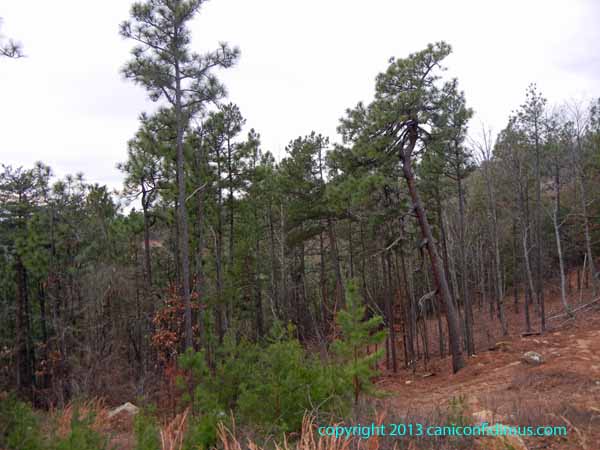
Mature longleaf pine

Mature longleaf pine

In this picture, the large tree to the right is a longleaf pine. The shorter trees in the foreground are loblolly pines. Behind the big longleaf there are some more longleaf pines and loblollies, along with the typical chestnut oaks that form the majority of the hardwood forest on Lavender Mountain. This lot has been partially cleared and trails have been bulldozed to allow the owner and his friends to drive their off-road vehicles.

I did some reading, and the more I read, the more interested I got. I found the Berry College longleaf pine restoration project in the link above. I thought maybe they didn’t know of the stand near our house, so I contacted Martin Cipollini, who runs Berry’s project. I had suspected that Lavender Mountain was close to the most inland and upland extent of the pine’s range, and he confirmed that, although he said there is another stand somewhat further north.

Once I realized what the longleaf pine was and how it looked, I started seeing them here and there around the mountain. The longleaf has a distinctive look to the needles. Most of the other pines in this area tend to grow needles along the length of a branch up to the tip so that they look like a horse’s tail. The longleaf grows its needles in a round clump at the end of a branch. It looks like a cheerleader’s pom pom. I find it fairly hard to tell some loblollies from a longleaf under some circumstances. Their needles can be long enough to confuse me, a naïve observer. But I usually have no confusion when I actually see a longleaf. That means that if I’m not sure, it’s almost certainly not a longleaf.

There are singletons scattered around, if you know to look for them. I was a little envious to find one growing on an adjacent lot just down from us, near our property line. I almost convinced myself it is on our side of the line, but it isn’t. And then I was excited to find a big one growing on the lower slopes of our lot, surrounded by other types of pine. It’s really hard to see, and I have to convince myself occasionally that it’s really there. It’s surrounded by the weed-like Virginia pines that colonize the disturbed landscape, and a few loblollies. But it’s there. (Now I have to check again.)

These longleaf pines are remnants of the huge stands that were so characteristic of the southeastern forest. They survived the loggers and the sap collectors because they were up on steep ridges that made harvesting the trees impractical. They have remained there for many years, like isolated pools left on the beach as the tide recedes. I think it has probably been at least a century since the rest of the longleaf forests in this area were finally eliminated.

It’s an interesting tree, and different from the other pines of this area. Most pines grow fairly quickly from seedlings, and from the beginning they have a shape not too unlike their mature form. But the longleaf grows slowly, especially at first, and in three distinct stages. The first stage is called the grass stage. In this stage, it is a clump of needles at ground level that looks more like ornamental grass than a tree. Apparently this stage can last up to seven years. At some point, depending on the growing conditions, it initiates upward growth. The trunk will grow, pushing a pom-pom of needles upward with no lateral branches. I have seen trees in this stage up to around six feet tall. This stage is called the bottlebrush stage. It doesn’t usually last as long as the grass stage, but I have seen some that don’t seem to have changed for several years.
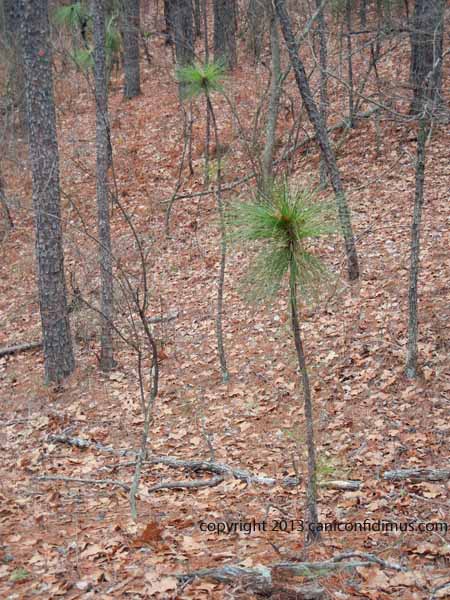
Longleaf in the bottlebrush stage

Longleaf in the bottlebrush stage

There are at least two longleaf pines in the bottlebrush stage in this photo. There is one in the background that looks like it might be just starting to branch out. They are quite distinctive, and unlike other pines at this stage of their growth.

A tree in the bottlebrush stage continues to grow comparatively quickly for a few years, eventually sprouting branches and growing taller. It takes the longleaf about 30 years to produce fertile seeds and a tree can live 300 years. There are some reports of trees up to 120 feet tall. None of ours are anywhere near that big. I have no idea how old they are.

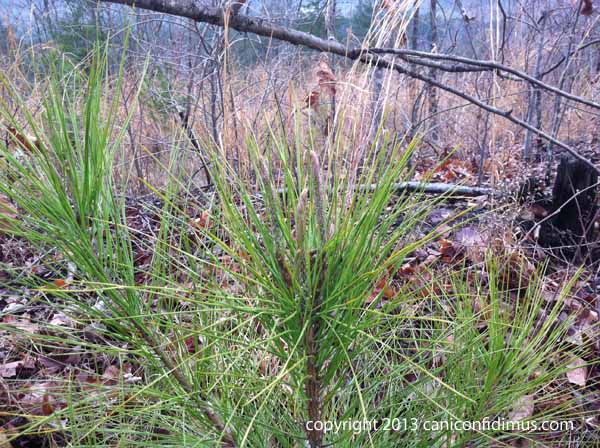
I have found a few grass stage longleaf pines on the slopes and in the woods not far from our house. I have also seen some grass stage and adult trees destroyed by off-roaders and by companies contracted to keep powerline rights of way clear of trees. I have watched a couple of large trees slowly decline and die, I assume as a result of the large gashes on their sides caused by off-roaders scraping by them. So when I found several grass-stage trees in areas where I knew they could not survive, I dug them up and brought them home. Unfortunately, it turns out that the grass stage tree, although not tall, can have a deep taproot. Because of the areas where I found them, it wasn’t possible to excavate very deeply, and I ended up unable to get much of the taproot. I took five home. Three died fairly quickly. One survived a couple of years and then died. One has lived. It’s overshadowed by the Virginia pines that infest this area, but I have thinned some of their limbs and the little longleaf actually seems to be doing pretty well. It has continued to sprout new needles and get larger. In fact, it is just starting its development into the bottlebrush stage.
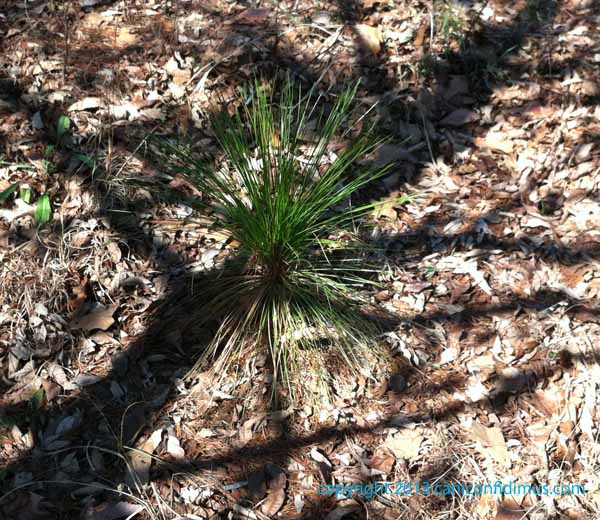
Our baby longleaf

Our baby longleaf

I might be optimistic, but I think it’s starting to show a little trunk under there.

People who live in areas with healthy longleaf forests might wonder why they seem so fascinating to me. But they are rare up here now, and I get some satisfaction from helping at least one little longleaf baby along its journey in life.