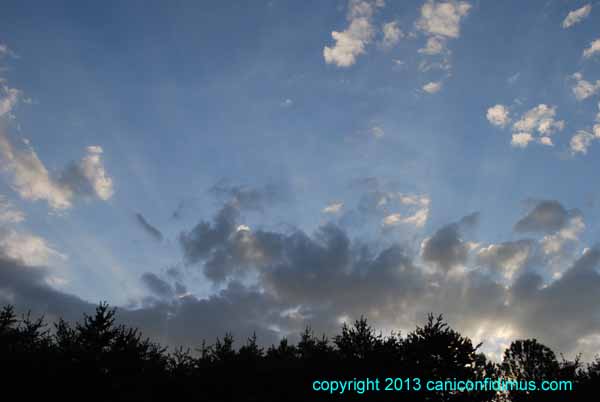
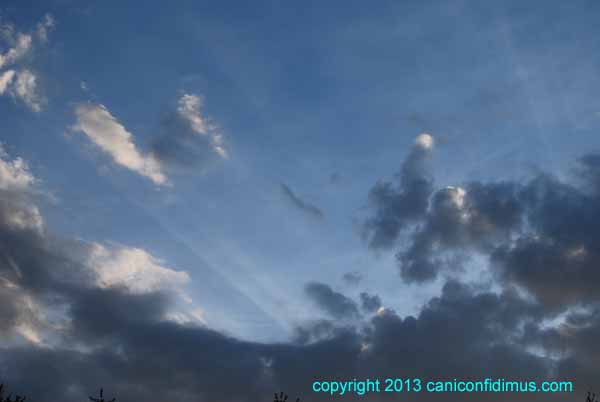
On the Friday night when we saw crepuscular rays, we also saw waves.
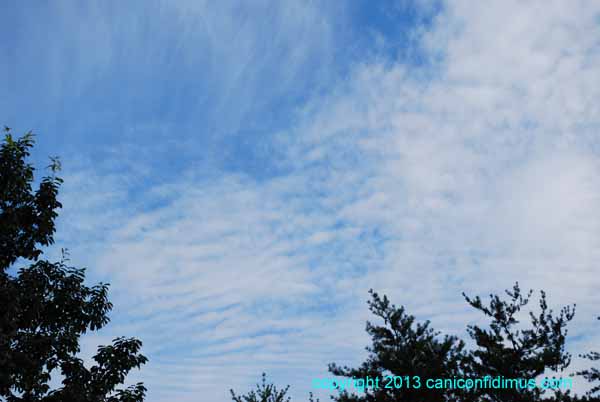
Faint waves
I had been watching the sky in hopes of seeing waves for quite a while, but it seemed that they were either not there when I had a camera or I didn’t have a camera when they were there. So I was happy to see these waves, although they are not the best examples.
These waves are probably typical of the size we think of when we think of cloud waves, but atmospheric waves range from very small, just millimeters in length, all the way up to the size of continents. Sound waves are a good example of the smaller waves. Frontal boundaries that the TV weatherman talks about are good examples of the biggest waves in the Earth’s atmosphere.
Sound waves are compression waves; that is the air particles move back and forth in the same direction that the wave moves. The other type of wave, the ones you see in the clouds, are transverse waves. The particles in transverse waves move perpendicular to the direction that the wave moves, like the surface of water waves.*
Almost the only time we can see atmospheric waves is when clouds form, and, despite how it looks, the clouds are not the top of the waves. Atmospheric waves that travel horizontally, like water waves, may also propagate vertically. If the wave happens to be in a part of the atmosphere that has water vapor that’s close to the point where it condenses, clouds may form. The water can evaporate in the trough of the wave and condense in the form of clouds at the peak of the wave. If the conditions aren’t right, the clouds don’t reveal the waves.
There are other conditions when you can see a wave without clouds, but you might want to stay away from them. A shock wave is created when there is a &imgrefurl=http://www.bbc.co.uk/1/hi/sci/tech/8569953.stm&h=288&w=512&sz=19&tbnid=PVcd37uQacDz2M:&tbnh=70&tbnw=125&prev=/search%3Fq%3Dexplosion%2Bshock%2Bwave%26tbm%3Disch%26tbo%3Du&zoom=1&q=explosion+shock+wave&usg=__p7sP0KL0BLNx4DsVyPXUVWCSLcM=&docid=r2YQl9k-AdhmFM&sa=X&ei=vnrXUarfC4jS9QTo9oC4Dw&sqi=2&ved=0CDoQ9QEwAg&dur=306#imgdii=_” target=”_blank”>large explosion, and if the conditions and viewing are right, you can see the wave front because the highly-compressed, dense air at the wave front refracts the light.
Waves in the atmosphere are caused by some kind of disturbance to the air flow. It can be something outside the air, like air moving over a mountain range (&imgrefurl=http://en.wikipedia.org/wiki/Orographic_lift&h=203&w=320&sz=23&tbnid=2WbFevhVqvRPvM:&tbnh=76&tbnw=120&prev=/search%3Fq%3Dorographic%2Bwaves%2Bin%2Bthe%2Batmosphere%26tbm%3Disch%26tbo%3Du&zoom=1&q=orographic+waves+in+the+atmosphere&usg=__mUCs8RxShhAjyoG0LuKI8vDeCAw=&docid=HDav7_YpO0p_uM&sa=X&ei=nnvXUfG9G4zY9QTnzoCoDA&ved=0CEAQ9QEwBA&dur=349″ target=”_blank”>orographic waves), or it can be something happening in the air itself, like winds moving in different directions or at different speeds at different levels of the atmosphere. That was the case for the waves here. I could tell that there were at least two levels of clouds, because some clouds were moving relative to other clouds. Puffy cumulus clouds were scooting across the sky, and the clouds where the waves formed look stationary compared to them. The waves formed at the interface between those different layers of air.
A little later in the evening, the sun told us that the clouds were at a minimum of three levels.
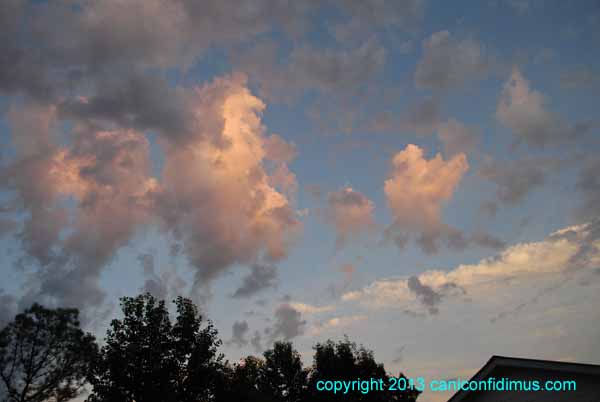
Clouds at three levels of the atmosphere
It’s not immediately obvious which clouds are higher than the others, but the highest clouds are white, because they are in the full sun. The middle level clouds are reddish, because the sun’s rays are traveling on a long path close to the horizon and have lost a lot of their blue light. The lowest clouds are dark, because they are so low that they are in the Earth’s shadow.
There are some great pictures of cloud waves on the Web, even &imgrefurl=http://www.telegraph.co.uk/earth/earthpicturegalleries/5400324/Extraordinary-Clouds-and-The-Cloud-Collectors-Handbook.html?image%3D9&h=400&w=620&sz=28&tbnid=ACYEQElJY98v8M:&tbnh=90&tbnw=140&prev=/search%3Fq%3Dcloud%2Bwaves%26tbm%3Disch%26tbo%3Du&zoom=1&q=cloud+waves&usg=__yxA66cIdDVudsBA0T36SfS7nJUk=&docid=sIeX93cj6EW5FM&sa=X&ei=QnzXUaqVFZTW8gSx8YGYDQ&ved=0CDwQ9QEwAw&dur=357″ target=”_blank”>breaking waves, much more dramatic than mine. I’m going to keep the camera handy, just in case I get a chance to catch some of them.
* If you happen to have experienced an earthquake, you probably already know about the two types of waves. In an earthquake, compression waves, called primary or P waves, hit first. Transverse waves, called secondary or S waves, arrive later. Geologists can use the time difference in the arrivals to estimate how far away the epicenter was. Back here in Georgia, although we have a lot of earthquakes, we rarely have one severe enough to really notice, and very infrequently is there an earthquake strong enough to feel the S waves. Around 10 years ago there was one strong enough to notice. It happened in the middle of the night, maybe around 3 am. A sudden shock woke me up. It was like someone had kicked the bed or a heavy weight had fallen to the floor. A few seconds later the room started to sway, like a boat bobbing in waves. The effect of the P waves was eerie. It made the world seem like a very different place from the one I was used to, where rooms stay put. The initial P wave effect seemed more familiar, because it was just like what we used to feel when there was blasting at the rock quarry about a mile from where I lived as a kid. I tried to find that earthquake in a USGS database, but I can’t identify it. There were at least three with a magnitude of 4 or greater in 2002 and 2003. This magnitude is high enough that the earthquake is noticeable indoors and may cause objects to fall, but rarely causes damage.