The fox’s tip

If you read our last post on the fox situation, you might remember that our attempt to help a crippled fox has had unintended consequences. We had thought to try to solve two problems. The first was that a fox was eating the food Leah puts out for the outside cats. Her practice has been to put some food in the garage, where Sylvester and Smokey eat, and some outside in the driveway for Chloe, Dusty and Rusty. Sylvester and Smokey chase the other three away, especially Dusty, and keep them from having free access to the food in the garage. That’s why Leah started feeding the three cats out in the drive.

Unfortunately, that also attracted a fox. Leah got into the habit of feeding the cats fairly often during the day, so the cats didn’t feel any need to eat their fill at any given time. So, Leah left the food out, and the fox ate it.

The second problem involved a female fox who suffered an injury to one of its front legs. It seems to be permanently crippled. So we decided to put dog food further out in the driveway, hoping to keep the fox from eating the cat food, and at the same time, hoping to keep the crippled fox alive.

We had reservations about this in the first place, but now we have had serious second thoughts about feeding the fox. Or, as it turns out, the foxes. The one crippled fox has turned into a family of at least three, possibly more. They eat the dog food, and then they eat the cat food. So we have decided to stop feeding the foxes and let nature take its course.

Things are never as easy as they seem at first. Feeding the fox seemed like a simple solution to two problems, but it didn’t work out as we expected. And now not putting out food specifically for the fox isn’t working out all that well either. We still have the problem of the foxes eating the cat food. We have to try to come up with a way to feed the cats but prevent the foxes from eating all their food. So far the foxes don’t come into the garage, but Sylvester and Smokey also keep Chloe, Dusty and Rusty out. I suggested putting their food out twice a day for a set, short period and then taking it up. Leah worries that they will get hungry because they’re used to grazing all day. I say that they will quickly learn to eat when the food is out. We haven’t decided exactly what to do, but it’s obvious that leaving cat food out in the driveway all the time isn’t working.

But what about the title of this post, The fox’s tip? Well, over the past few weeks we have noticed an odd behavior of the foxes. They poop in their feed bowl.
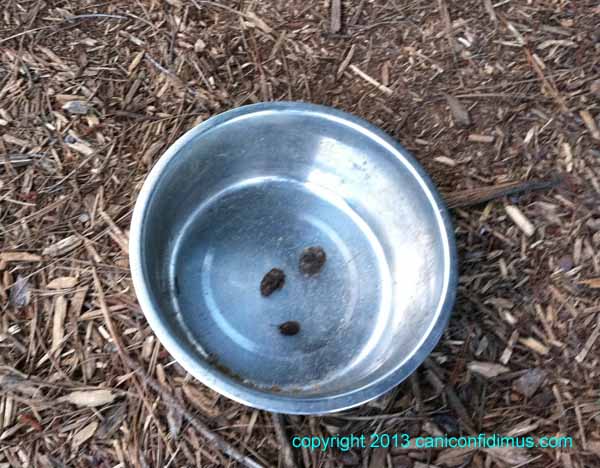
Is this what a fox calls a tip?

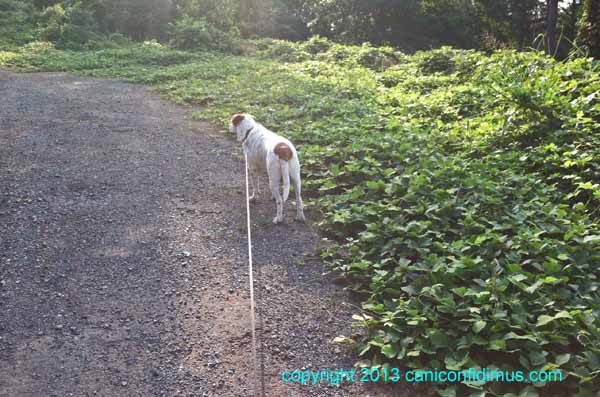
Still life with dog food bowl and fox poop.

Is this what a fox considers an appropriate tip for services rendered?

I assume there is a reasonable explanation for this behavior, but I don’t know what it is. Territory marking? Preventing another animal from feeding at their site? Convenience? Watching Zoe’s bathroom habits?

Ain’t she sweet?

Leah and I got married in 2005, but I’ve known her for a long time. Leah’s brother Dan was my best friend in high school, and I can remember having my mother drive me over to his house when I was 15. I probably caught a glimpse of her then, when she would have been 11.

Over the years I caught more glimpses. In the summer when I drove over to Dan’s, if Leah was sunbathing in her two-piece swimsuit, she would jump up and run for the house when I pulled up. I always thought she was cute. And she had great legs.

Here she is with that great new Beatles album, Abbey Road. She’s probably telling her cousin about it.

Leah and the Beatles

Leah and the Beatles

Abbey Road was released in 1969, when I was 19 and Leah was 15. Isn’t she cute? Darn right she is!

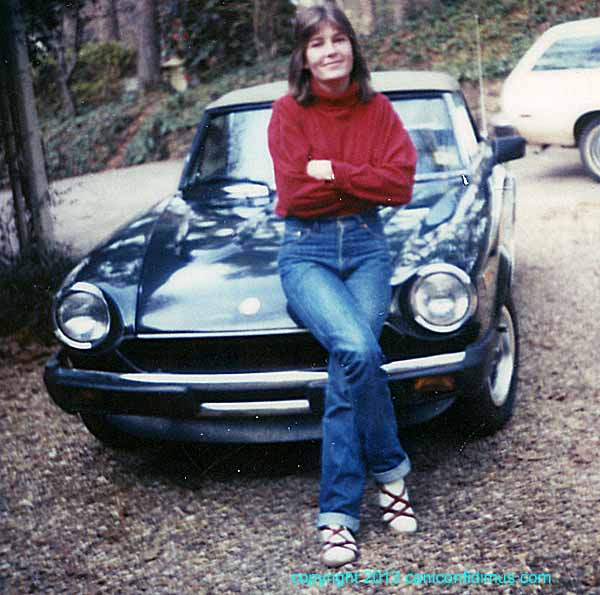
Although I always liked Leah, we never connected. It turned out that when I went to graduate school at Georgia Tech in Atlanta, she was working there. This is what she drove.

Sharp car! Nice girl!

Sharp car! Nice girl!

That’s a Fiat 124 roadster. A lot of people think old Fiats were unreliable, but I disagree. I got a 1971 Fiat 124 Sport Coupe just before I graduated from Georgia State University in 1973 and drove it for a long time with no problems. It had nearly 100,000 miles on it when I sold it, including a cross-country trip to California and back.

Leah did have some problems with hers, and her mother suggested that she call me and see if I could help. I wonder, was there an ulterior motive there? I regret that I couldn’t really fix the problem.

Leah offered to make dinner for me, but that just never seemed to happen.

Not long after, the poor Fiat met its doom in a close encounter with a telephone pole.

And I went on at Tech, and then later in Huntsville. Sometime in 1998 or 1999, Leah and I got in touch with each other again. And the rest is history

But boy would I like to have that car.

Hummer trap

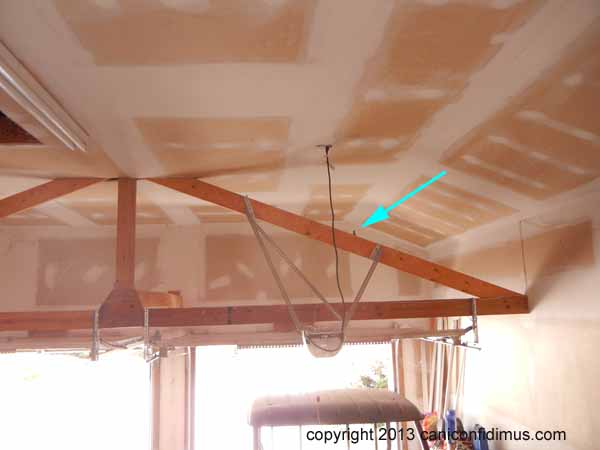
Our garage is a hummingbird trap. On at least four occasions hummingbirds have flown into the garage and then been unable to find their way out. The problem is that the garage  ceiling is four or five feet higher than the top of the garage door. The birds fly in and then up. Even with both garage doors open and bright sunlight outside, they never try to get out any other way than by flying up towards the ceiling, where they bump and skitter along the surface.

On three previous occasions we were able to help them escape. One time I turned the ceiling light on so it would fly near it; they are attracted to the light like a moth. I climbed our eight-foot ladder and stood with a towel ready right next to the light, and when the hummer lit on the towel, I gently folded it around the bird. Another time I held a broom up and it lit there. I lowered the broom slowly and brought it to the open the garage door. The hummer flew out.

The third time was distressing. This little bird flew around so frantically that it exhausted itself and fluttered slowly to the floor, where it lay there panting. I scooped it up with a towel and put it on a branch of one of our shrubs next to the drive. It sat there for a while and then flew up into a nearby tree.

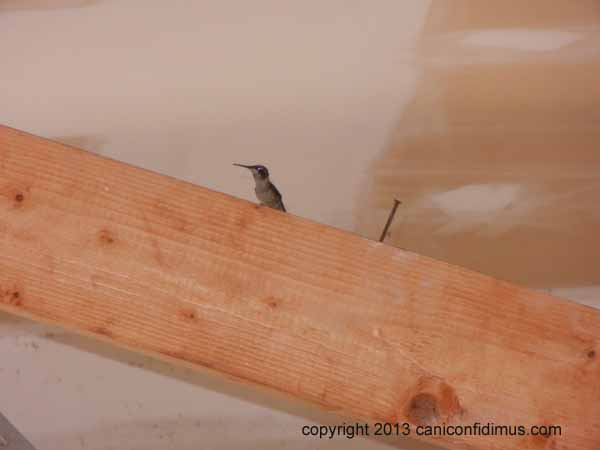
Today was the fourth time, at least that we know of. Here it is perched on one of the garage door supports.

The trapped hummingbird

The trapped hummingbird

Our hummers are ruby throated. The ruby throat is not present on this one, so it must be a female. Here is a shot taken at the same time but zoomed out. You can see how high the ceiling is here.

Taking a rest

Taking a rest

The arrow points to the bird taking a rest. This one would fly a circuit around the ceiling a few times and then perch where she is now or on the corresponding point on the other side of the brace. When it lit, it would look up and around like it was trying to figure out why it couldn’t get to the sky.

We tried for a long time to help this bird escape, but every attempt failed. I tried closing the garage doors and turning on the light so it would fly close to it. But it was skittish and wouldn’t come close enough for me to get it. It ignored the broom I held up. I put a feeder on a tall pole and offered it to it, but it wouldn’t light on it.

It’s funny to think about it, but even birds are individuals. One of the hummingbirds that became trapped didn’t seem afraid of me, so it flew close enough for me to grab it. One obligingly lit on a broom so I could take it outside. Another never perched anywhere, so it eventually exhausted itself. Today, the hummingbird avoided me. There seemed to be no way to save this little bird.

I had work to do in the yard, so I came and went through the garage, checking every time I went through. Finally, one time when I looked, it was gone. I looked around on the floor to see if it had tired out and dropped to the floor, but I didn’t see it. I also looked for feathers, since the cats were never far away, but I didn’t see feathers either. We hope it finally flew low enough to notice the open doors and flew out. But we really have no idea what happened to this little bird.

If she made it out OK, I hope she tells here friends to avoid the big open spaces on the front of the house.

The Green Tide

Kudzu is one of those things that seemed like a good idea at the time. It was introduced in the United States from Asia at the Philadelphia Centennial Exposition’s Japanese Pavilion in 1876, and in the South at the New Orleans Exposition in 1884-86. It seemed like a miracle plant. It was hardy and fast-growing, it tolerated poor soil, livestock liked to eat it, and it had a wonderfully fragrant flower. What could possibly go wrong? By the 1930’s, it was promoted as a livestock food for farmers to grow. By 1935 it was promoted as an erosion-control plant, and Soil Conservation Service nurseries began producing seedlings. According to the New Georgia Encyclopedia, between 1935 and 1942, Soil Conservation Service nurseries produced a hundred million seedlings. They were  spreading this stuff everywhere.

By the 1950s, people were having second thoughts. Today it has been reported as an invasive species in states from the Deep South, as far up the Atlantic coast as Connecticut, and in Oregon and North Dakota.

And right here just down the street from us.

I, for one, do not welcome our kudzu overlords

I, for one, do not welcome our kudzu overlords

Kudzu has a kind of mythic and yet comical status in the South. One of the Atlanta television stations had a news helicopter that used to routinely report on the various objects that kudzu was covering, from abandoned houses to old school buses. I suspect that it’s not so funny if it’s your property that the kudzu is invading.

Look out Zeke!

Look out Zeke!

This is on Lavender Trail across Fouche Gap Road, where kudzu has covered several boulders that mark the edge of the road at the dead-end turnaround.

One of my uncles, since deceased, liked to tell tales. He had a small farm and was pretty familiar with farming. He said that kudzu was great food for cattle, but if you planted it in a field, although the cattle would eat it, it would eventually spread beyond the fence. He said the only way to safely plant kudzu was to put a fenced area within a cattle pasture and plant kudzu within that interior pen. The cattle would then eat any kudzu that tried to spread outside the pen. It was hard to know whether to take him seriously or not.

This is what can happen if kudzu is not controlled. I found this image online, but it’s not an uncommon sight around here.

Online image of kudzu covering trees

Online image of kudzu covering trees

The kudzu on the mountain was blooming this week. Kudzu blooms have a deep, strong, sweet odor. Sometimes you can smell the blooms from quite a distance. In this case, I had to pull a bloom close to my nose to smell it last weekend. By this weekend, although the blooms were still visible, I couldn’t detect any odor at all.

Kudzu flowers

Kudzu flowers

There is a patch of kudzu growing across the street from one of our neighbors down on Fouche Gap Road. Now it has spread to the ditch in front of their house. I’m afraid it’s a mistake to allow that to happen.

I am keeping an eye on the kudzu growing on the property next to our neighbors on the other side of Wildlife Trail. It has covered and killed several large trees, and it’s trying to send tendrils across Lavender Trail. That would put it in the yard of our neighbor on the other side of Lavender Trail. Our neighbor’s yard and Wildlife Trail serve as a firebreak, but I don’t entirely trust it.

Another old picture

I’m sure no one finds these old pictures as interesting as me, but here’s another one. It’s a scan of a Polaroid that had a lot of dust on it.

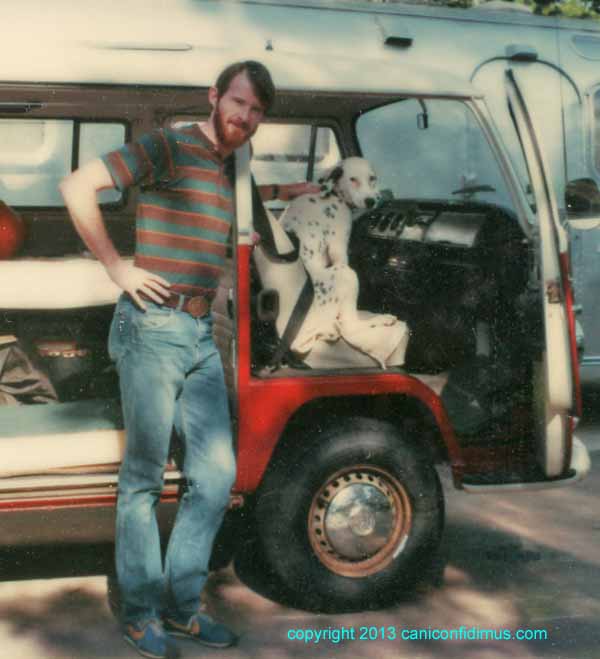
Me, with Jesse riding shotgun

Me, with Jesse riding shotgun

This was taken in 1979. I was 29 and had only recently adopted Jesse. As you can see, my hand is on Jesse. Any time I was close enough to touch her, I had my hand on her. The VW is a 1972 bus, the best of a dozen or so that my friend Errol and I looked at in Atlanta. Jesse and I were getting ready to take a trip in this picture. We went up to New Kensington, Pa, to see my brother, and then out to Colorado and New Mexico to visit Errol’s brother Tom.

I’ll point out a few things of interest. Behind me you can see two foam mattresses. The lower was Jesse’s at night, and the higher one was mine. My father figured a way to span the gap between the third row seat and the driver’s seat with a bunk. It worked great. Jesse rode on the bunk during the day with her head on my shoulder. She was a good traveler.

You can see that there was a time that I had no gray hair in my beard, and I had a full head of hair. And no spare tire. For any runners, the shoes I am wearing are the great-grandfather of all modern running shoes, the Nike Waffle Trainer. I bought a pair of them in San Francisco in 1977 to train for and run in a marathon held near Carson City, Nevada. My knees worked in those days.

The Airstream trailer in the background was the one my parents used for several years to travel all over the country, and into Mexico and Canada.

The VW had the same old air-cooled four-cylinder engine that the Beetle had. It would do just about 60 miles per hour on the highway. It had no air conditioning, but if you opened the driver’s window and cranked the huge sunroof open a little, there was a smooth, relatively quiet flow of air through the cab. It was bearable even in the summer. In the winter, however, the pitiful little puff of lukewarm air that came through the heater vents was just about enough to keep frost off of your toenails.

Jesse and I spent a lot of nights in that old VW. We stayed in campgrounds, in rest areas and in parking lots.

There is really no context in which you can say that an old VW bus was a good car. It was slow and dangerous. On the front end there was literally nothing but a thin piece of sheet metal between you and the world. The rule was, if it looks like a car is going to hit you, lift your legs.

But I miss it.

When I say I would like to have it back again, what I really mean is that I would like to be 29 again.