Grasshopper revolution

If you watch Fox news or listen to much AM talk radio, you have probably heard of Dave Ramsey. He is a popular personal financial advisor with books, seminars and a call-in radio show. When I was working more regularly in Huntsville and had to drive somewhere around lunchtime, I would sometimes listen to his radio show because there was nothing else on. If you can get past his self-satisfied expressions of his Christian beliefs and right-wing politics, he has some reasonable advice for people who buy cars they can’t afford and run up huge credit card balances. What he tells them to do is to stop using their credit cards, pay off their debts, stop buying things they can’t afford and get onto a budget.

Fine advice, but I sometimes have to turn off the radio when he gets too deep into his personal religion and his politics, which don’t seem too … let’s say, progressive. “Christian financial advice” seems self contradictory to me. I am pretty sure there are no words attributed to Jesus in the New Testament that are favorably inclined towards wealth or the accumulation of it. The verses I can remember are things like Jesus telling the rich man to sell all he has and give the money to the poor, or how hard it is for a rich man to enter heaven, or that a man can’t serve both god and money. I never heard Dave Ramsey advise anyone to sell all their possessions and give the money to the poor. Not even close, not even once. He is far more likely to advise people to follow the habits of the rich.

But, back to the point.

One thing Ramsey likes to tell people is that if you live like no one else today, later you can live like no one else. Putting aside the weak rhetorical structure, what he is advising is that people should live frugally, eating rice and beans, saving their money and paying off their debts, so that later they can live like rich people.

I have no problem with most of that. Leah and I have no debt. We own our house and pay off our credit card in full every month. We are pretty frugal. And I like rice and beans, although I can’t convince Leah that they make a perfectly good meal, even without meat.

But I don’t like the principle behind Ramsey’s saying. Basically, it’s the old puritan principle of deferred gratification.

My work history, as shown in my Social Security earnings record, looks kind of spotty. I have spent a large percentage of my working life not working. In fact, I have a pretty solid record of quitting whatever it is I’m doing if I don’t like it. I’ve dropped out quite a few times, both from school and from work. Since about 1997 I haven’t even had a full-time job. I have worked as an independent contractor, which has allowed a work schedule more suited to my personality.

For 55 years, or at least the adult part of that, I never gave much consideration to money or what I would do for money in Dave Ramsey’s “later.” When I traveled, I usually spent the nights in the bed of my truck with the dog, and I figured I could always do that “later.”

All of this is just to point out that I am not an ant. It’s not that I have spent all my money, I just never really planned for retirement. That is, until I got married. Leah has never thought it was very funny when I suggested our retirement home should be under one of Rome’s bridges. We’ve been doing some serious work on retirement savings, so I don’t think we’re going to have to do that, but I still don’t believe in Dave Ramsey’s deferred gratification philosophy. I don’t think you should put off doing thing until later, because later may never come. Instead of “live like no one else today”, how about “gather ye rosebuds while ye may” or “carpe diem” or even “there is no time like the present”?

Or, how about one of Charles Schulz’s Snoopy sayings? Charles Schulz died almost 14 years ago, but his comic strip Peanuts has lived on. I’m glad, because I have been looking for one of the Peanuts strips, and it recently appeared in the Atlanta paper. In this strip, Charlie Brown brings Snoopy two bowls of food and tells Snoopy that he will be gone the next day, so he should save one bowl for tomorrow. Snoopy eats one bowl and returns to lie on his doghouse. He resists for a while, but is eventually overcome and leaps on the second bowl and eats it. Then he lies on the roof of his doghouse and says, “I’m glad I ate it … I would have hated myself if tomorrow had never come!”

I’m with you, Snoopy, you and the grasshopper.
Two bikes

When I started at Georgia State University in 1971, after the first quarter I roomed with my friend Tom in an apartment a few miles from the campus. Georgia State is in the heart of downtown Atlanta, not far from the capitol building. There is no parking anywhere near the campus. At that time, students were allowed to park in lots near the stadium, about a mile away. If you wanted to park on campus, you had to ride a bicycle. So I did. I bought a cheap, heavy 10-speed from Sears. It was about as crude as a bicycle can be, but I rode it almost every day until I graduated in 1973. I rode it rain or shine, cold or hot, in heavy traffic or light.

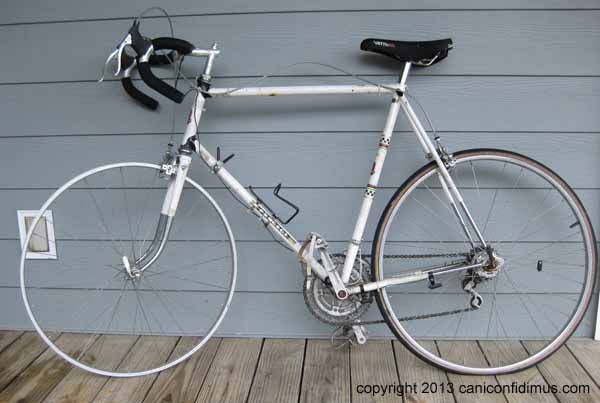
After graduation in the spring of 1973, I got a job as a newspaper reporter in Augusta, Ga., on The Augusta Chronicle (the “The” is part of the name). I started running then, but I still wanted to ride a bike, so I got some bicycling magazine review editions and decided on a Peugeot PX-10E. It was a nice, mid-level bike, not the cheapest and not the most expensive, not the best and not the worst. But it rated pretty highly, and I liked it. So I saved my money. That summer I found one and paid $270 for it, exactly twice my weekly salary.

Here it is.

My old Peugeot, without a front tire

My old Peugeot, without a front tire

This was a pretty serious bicycle at the time. It had tubular tires, also called sew-ups or glue-on tires. They were the lightest bicycle tire you could use. The tire had thin edges instead of a hard bead that holds it to the rim. It was sewn up around an inner tube that was so thin you could almost see through it. And then, since it didn’t have a bead, the tire was glued to the rim. I read that it was possible to repair a flat on one of these tires, but I never tried. I always just got a new tire and glued it on.

The seat was made of the hardest leather I have ever felt. The bicycling magazines said this was the best type of seat. They said if you rode enough, it would soften and shape itself to your own shape. I do not believe this. I soaked it in oil, pounded it with a hammer and drilled holes into it. It was still as hard as a block of wood. If I had tried to ride on that saddle long enough to soften it, I am sure I would have had serious, permanent nerve damage in my groin. I gave up and replaced it with a softer saddle.

Since it was French, it could have only French components. The derailleurs worked well enough as long as they lasted, but eventually they just sort of fell apart. Since they were French, of course a modern Japanese rear derailleur wouldn’t just bolt on. I had to jury rig it.I’ And eventually I got tired of replacing tires, so I switched the rims for clinchers, the standard type of bicycle wheel and tire that you see on virtually every bicycle today. It’s hard for me to believe now, but I actually laced the spokes to the new rim, tightened them and trued the wheels all by myself. I did a pretty good job, too.

I rode my Peugeot for a long time. When I quit the newspaper business and went back to school at Georgia Tech, I found a place to live that was only a few miles from school, and I commuted on my bike again. When I got a job in Huntsville, Al., in 1986, I brought my bike with me. When my knees started giving me problems, I started biking instead of running. At that time I rode a 20-mile course and at times actually averaged 20 mph over the course. It was nothing compared to a real bicyclist. I knew one at work who put more miles on his bike than on his car.

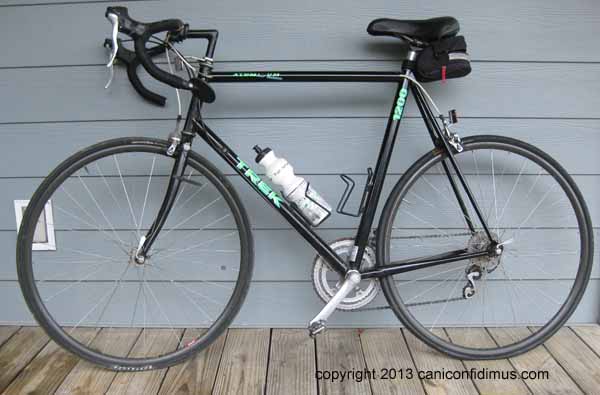
After riding my Peugeot for 20 years, I bought new bike. I got this Trek in about 1993.

My "new" bike

My “new” bike

I can’t remember how much I paid for it. I’m sure it was several times what the old Peugeot cost, but I guess spending the money then just didn’t make as big an impact on me as it did in 1973.

It has an aluminum frame instead of steel. When I first rode it I was surprised at how much better it felt than the old Peugeot. I haven’t ridden since summer before last, but I’m sure when the weather gets warmer again I will pick it up. This area is very popular with bicyclists. They like climbing Fouche Gap Road, and the ride around Texas Valley is nice.

As you can see, I kept the Peugeot. I haven’t ridden it since I got the Trek, but I just can’t bring myself to get rid of it. The Trek is my current bicycle, and I’m pretty sure it will be my last. Maybe one day when I get old and decrepit and I’ll sell both of them. Or maybe not.

Fog, glorious fog

On overcast or rainy days around here, it’s fairly common for the bottoms of the clouds to be lower than the top of Lavender Mountain. Those low clouds become thick fog for us up here on the mountain. Sometimes the fog closes in and visibility drops to a few dozen yards. We have had that kind of weather several times over the last few days.

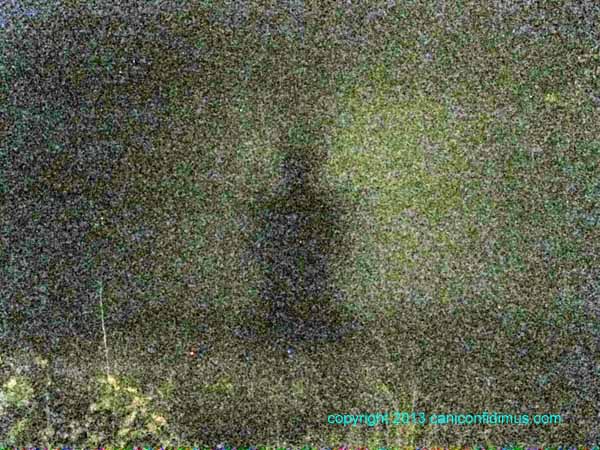
We have flood lights on the corners of the house and some bright low-voltage spot lights at ground level behind the house. When I walk the dogs around the house late on a foggy night, I cast a shadow on the fog itself. It’s hard to get a decent photograph of it. This is the best I could do.

My shadow in the fog

My shadow in the fog

I had to enhance this image in Photoshop Elements. That caused a lot of noise in the image that makes the fog seem grainy. But one thing you can see is the brightness of the fog around my shadow.

This is what you get when you use a flash. The reflected light completely washes out anything in the scene, and the resulting image is nothing but noise.

Nothing but fog

Nothing but fog

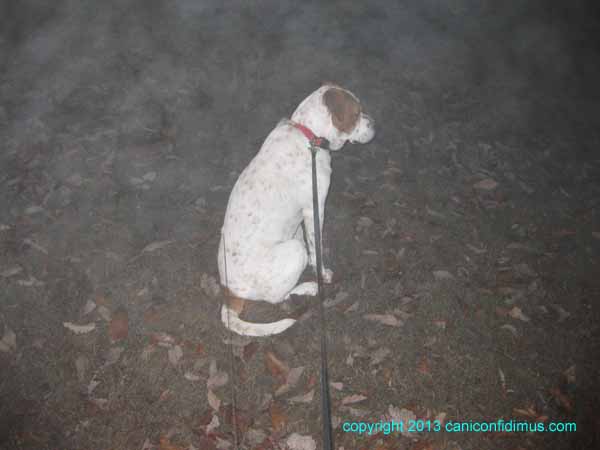
Zeke sat down to wait for me while I fiddled with the camera. I tried to get a shot of him, but, even though he was close and there did not seem to be much fog between us, this is all I could get.

Zeke in the fog, waiting patiently

Zeke in the fog, waiting patiently

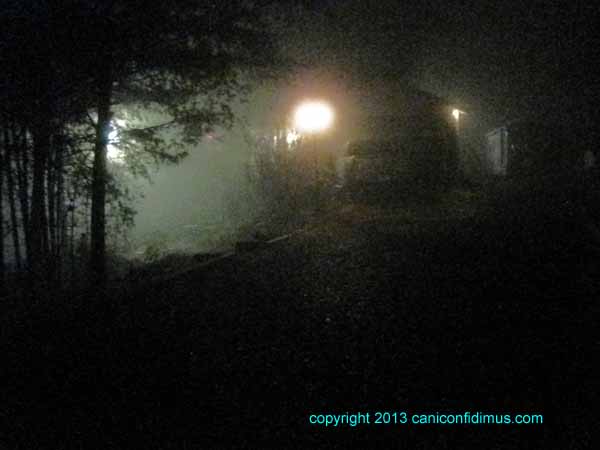
I took shot of the front of the house. It was a kind of neat scene, but it was also a hard image to get, especially with the little point-and-shoot camera I was using.

The front of the house

The front of the house

All of these images illustrate some of the interesting things that happen when light goes through fog. The effects are caused by the scattering of light from water drops. Water drops tend to scatter light strongly back towards the source. That’s what happened when I used the flash; a lot of light was scattered (reflected) right back at the camera, flooding the sensor and washing out anything that otherwise have been visible in the scene.

Light is also scattered strongly into the forward direction, that is, the direction that the light was originally traveling. When you see a bright light in a foggy scene, like the floodlights in the picture of the front of our house, you will probably notice that the light itself looks bright, but there is also a lot of glare around the light. That is light being forward scattered.

The way light is scattered into all directions around a water drop is called the scattering phase function. If you could see it plotted, you would see that some light is scattered into all directions around a water drop, but there is a lot more in the backward (towards the light source) and forward directions.

All this is fairly wonky, but it leads to some really neat things, like, for example, the glory. The glory has been noted for hundreds, if not thousands of years, mainly in regions with high mountains where the clouds are sometimes lower than the tops of the mountains. If a person is on the top of a mountain, and there are clouds below the top of the mountain, and the sun is behind his back, sometimes if he looks down towards the clouds, he will see his shadow cast on the clouds, and there will be something that looks like a halo around his head. That is the glory.

If two people are standing together looking down at their shadows, each one will see a glory only around his own body. It’s easy to understand why someone who doesn’t know what causes a glory to think that it must mean that the person who sees it is special.

Probably the most common place to see glories today is from an airliner. If the sun is in the right place, and the plane is flying over clouds, and you are in the right seat to see the plane’s shadow, you will probably see a glory around the shadow of the plane.

There are several explanations for the glory, but they seem unnecessarily complicated to me. It seems to me that the scattering phase function explains it pretty well. When the light is coming from directly behind you, your head will cast a shadow, but the light that passes around your head will be scattered strongly back towards the source; in other words, directly back towards you. Thus you will see a bright area around the shadow of your head. The glory is often colored, which also doesn’t seem to require a very complicated explanation, since a similar effect can be seen in every rainbow.

You can see a more pedestrian version of this almost any time the sun is out. Just stand so that you can see your own shadow. Most of the time whatever surface you are standing on will tend to reflect light more strongly directly back towards the source than in other directions. This will cause the ground or other surface to look brighter right around the shadow of your head. This is often a subtle effect, but if you look carefully you ought to be able to see it. A roughish surface, like grass, is better than a smooth surface like a concrete patio.

So, when you’re out looking around, keep looking up, but don’t forget to look down sometimes, too.

Our own brand of deer hunter

There are lots of deer around our neighborhood. We see them just about every time we drive in the evening on Technology Parkway, which goes through an industrial park developed on Berry College land. We see their bodies fairly often where cars have hit them, and have even seen one as it was hit. I hit one myself further out Huffaker Road. Mine survived long enough to jump up and run away. Several hang out near our house. Some of them have decided that our shrubs are a buffet, like they did a few years ago during the worst part of our drought.

Deer season for firearms opened here in October and lasts until January 1. Berry College, which owns 27,000 acres, has three short firearm seasons with 1000 permits for the first two and 750 for the third. Berry College extends along Lavender Mountain fairly close to us. It’s more than a stone’s throw away, but certainly within a bullet’s range.

Aside from the damage the deer cause our shrubbery, I am pretty much neutral on deer hunting. I don’t hunt and don’t really understand the appeal, but that’s a personal shortcoming rather than a judgment. Several of my coworkers hunt deer and they seem to be pretty normal people.

I’m sure most deer hunters are responsible citizens, but this area seems to have a significant population of a different kind. I mentioned seeing partially butchered deer carcasses dumped along Fouche Gap Road. I have seen them in prior deer seasons, but this season is the worst. I counted five confirmed and a possible sixth so far this year. There are four (or possibly five) within two miles on Fouche Gap Road and one on the few hundred yards that Wildlife Trail extends from our house to its dead end.

Apparently the practice is to take some meat off the main body of the carcass, leaving the rib cage exposed and the legs and the head untouched. Then the remains are tossed out of the back of a truck. Probably a truck, but who knows? Maybe these people haul dead deer in the back seats of their cars.

All I know for sure is that I don’t want to meet these people in the woods. Or any other place, for that matter.

A Thanksgiving story

When my brother was moving back to Atlanta from San Diego, he needed someone to drive his old car back east. My friend Tom and I thought it would be a nice trip, so we agreed to do it over Thanksgiving week. The details are fuzzy now, because it was about 20 years ago, but here’s what I remember.

First, of course, we had to arrive in San Diego without a car. Tom’s idea was that he would drive to Georgia from New Mexico in his little pickup, and we would drive back and catch the Amtrak train from Santa Fe to Los Angeles. It sounded good to me, so that’s what we did.

The first part of the trip was uneventful. We had both driven back and forth between Georgia and New Mexico many times, so the trip through Alabama, Mississippi and Tennessee was pretty boring. About the time we reached Arkansas on I-40, it started raining. Hard. We heard a weather forecast on the radio for snow, and we both thought it was ridiculous with all the heavy rain. But as we kept going into the night, it got colder, and the rain turned to snow.

It snowed hard. The interstate started getting slippery. Tom’s truck was four-wheel-drive, so we didn’t have much trouble, but we did have to slow down quite a bit. The highway was covered with snow that was packed by the traffic. We watched a big truck driving up a long grade curved to the left. The tractor was in the right lane, and his trailer was sliding along in the left lane.

It was pretty tiring, so we stopped for a while at a motel in Amarillo. The next morning had turned bright and sunny with only a few icy spots between Amarillo and New Mexico. We headed up towards Lamy, which is where the Santa Fe train station is located. We intended to buy a ticket for the next day’s train, but found that that day’s train was late. It had been behind a freight train that had come apart on a grade, so we were able to get tickets for a compartment on that day’s train.

We had a while to wait so we went over to the Legal Tender Saloon for a little nip, and then came back to the station. Tom was a fan of detective novels, so we joked about Murder on the Orient Express and whether there might be a death on the train.

It was so late after the delay that they started serving dinner almost immediately after we left the station. We went up to the dining car and sat down to eat. After a while, we looked outside and then asked each other whether the train was slowing. It was. Out in the middle of nowhere between Santa Fe and Albuquerque, a drunk had decided to take a nap on the tracks, and the train had run over him. The almost imperceptibly slow stop was called an emergency stop.

It was a long time before the ambulance and police cars came, and a lot longer before the train started again. And then it went almost immediately into a siding where every wheel was inspected for damage. Apparently that’s required after every emergency stop.

Eventually the train went through Albuquerque and then headed west across Arizona and into southern California.

I think traveling by train may be the best way in the world to travel. The western Amtrak cars are two stories tall, so you sit up high. In the compartment we had, the seats faced each other on either side of the window. There was almost no sensation of motion, just the western landscape passing silently by. At night the seats fold down to make one bed, and the upper berth lowers immediately over it. It was a comfortable ride, but I had a cold so it was hard to sleep. Even so, when I got off the train in LA, I felt like I had just walked out my front door. There was none of the drone and low oxygen levels of airline travel, which usually leaves me exhausted after a four or five-hour flight.

We rented a car to drive down to San Diego. My brother, who was back in Georgia, had told me that his car, a 1967 Porsche 912, would probably need a tune-up. We got some tune-up parts and I started working. The car kept running worse and worse as I worked, but finally, at the end of the day, I had it running about as well as it had been before I started. At that point it seemed best to consider the job done.

We left the next morning. It was ice-cream weather in San Diego, but the cold weather we had passed through in the middle of the country was still there. In case you’re not familiar with old Porsches, I’ll explain. The 912 looked exactly like its bigger, more expensive brother, the 911, but it had a four-cylinder, air-cooled engine more powerful but otherwise not much different from an old Volkswagen’s. Since an air-cooled engine doesn’t have cooling water that can be used to heat the passenger compartment, Porsche and Volkswagen got heated air into the cabin by putting an envelope of sheet metal around the exhaust manifold and a blower to push hot air from the engine at the back up ducts to the front of the car. It’s a perfectly logical solution, as long as there are no exhaust leaks, but it sounds much better in theory than it works in practice. We never could feel any heat from the little vents. Riding inside the 912 didn’t seem much warmer than some of the cold days I have spent on a motorcycle.

When we decided it was too cold to take it any more, we found a K-Mart and bought a Sterno stove. A Sterno stove uses a little can of jellied alcohol placed in a small, squarish metal stove. You light it with a match and it burns with a weak flame. We put it down in the floorboard between the passenger’s legs. The main problem with it was that it produced a lot of water vapor that kept fogging the windows.

This seemed like a good idea at the time, but it was probably a worse idea even than the original Porsche heating system. It did, however, provide enough heat that we were almost comfortable.

Around that time the Porsche’s starter stopped working. Our first idea was to make sure we parked on a slope so we could push it off. That idea also turned out not to be so good, but at least it gave us some exercise. After one stop, we couldn’t get the car started again until someone stopped and helped push it off. After that we decided to simply drive straight through the rest of the way without turning the engine off. That might not have been a good idea, but it worked.

On Thanksgiving day, we pulled into a truck stop, filled up the tank and parked in front of the truck stop restaurant. We left the engine idling and went in for our Thanksgiving Day dinner.

We managed to make it back to Georgia without any further adventures. We parked the car in my parents’ driveway in Rome and turned the engine off. My brother had to come up from Atlanta to get it. I think he had a hard time getting it started again. I don’t remember how Tom got back to Lamy to pick up his truck from the train station.