Good day sunshine

Is there a better feeling than lying in the sun on a clear, cold, windy day? No, at least if you ask the dogs.
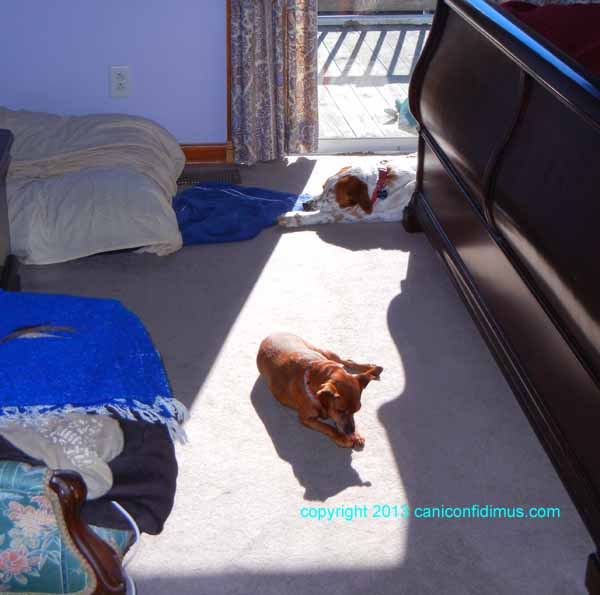
dogs in the sun

We wait until the sun is high enough to give some warmth before we open the curtains, so sometimes there’s very little sunlight when Lucy comes into our bedroom.
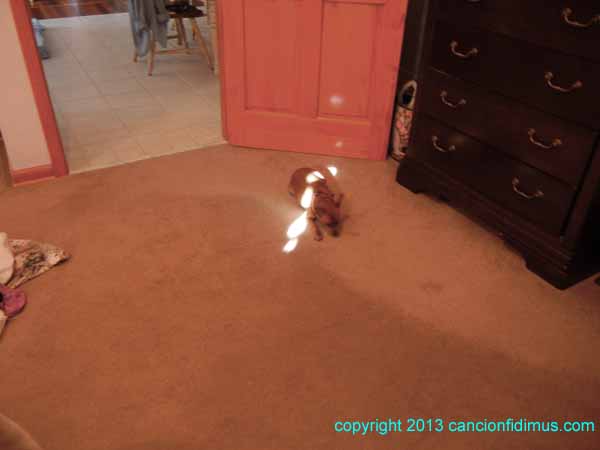
a little sun

There’s a little sliver from the window. A little sun is better than none.

Zoe likes to lie in the sun, but sometimes he mistakes the location of his head for the location of his entire body.
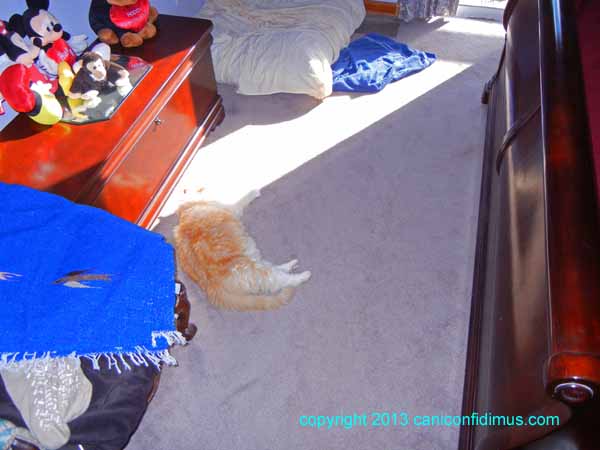
cat on a hot carpet floor

But perhaps I do him a disservice; perhaps he simply wants to adjust his solar gain and thermal emission to maintain a constant, comfortable internal temperature. Yes, that must be it.

It’s no accident that the rear of our house faces south. When I was laying out the foundation lines for the house, I wanted the rear of the house to face as close to due south as I could manage, because I planned to have lots of windows in the south-facing side. One day I put a stake vertically in the ground, calculated the exact time of local solar noon, and waited. When it was solar noon, I made a line along the shadow of the stake. I used that line to define the direction that the house’s rear would face.

I could have simply used a compass, or waited until my watch said it was noon, but I wanted to be as accurate as possible, and both of those methods have problems. The compass would have shown me magnetic north, which, where we live, it is about four degrees away from true north. And, since each time zone is 15 degrees wide in longitude, the sun’s position at civil noon varies depending on where you are in the time zone. We are close to the western border of the Eastern Time Zone, so there would have been several degrees error from that.

Using a compass would have worked pretty well, all things considered, but since I knew the longitude of my house from a GPS receiver, I could calculate how far solar time is away from civil time, and, theoretically, get closer to true north.

Unfortunately, the sun’s azimuth (the compass direction from which the sunlight is coming) at noon at a given location varies through the year, so unless you put the stake in the ground on exactly the right date, your stake’s shadow will not point in a true north-south direction. Depending on the date, the sun’s azimuth can be a few degrees away from true south (in the northern hemisphere) at solar noon. However, a true north-south line would be the best orientation. Since the sun’s azimuth varies on both sides of the north-south line, that line would be closest on average to the sun’s azimuth.

My line was only a few degrees at most from a true north-south line, close enough that it makes very little difference in how much sun we get on a cold winter day. I could and maybe should have calculated the optimum roof overhang to provide shade in the summer and minimum interference with solar gain in the winter, but what we have is just about right.

We have six-foot sliding glass doors in the bedrooms and an eight-foot sliding glass door in the living room. We keep one side of the door in our bedroom covered with an insulation panel, so we only get half the possible solar gain in the bedroom, but that’s plenty on a sunny day. Even on sunny days when the outside temperature is below freezing, the bedroom temperature will exceed 70 degrees without running the heat. The living room will do the same.

I didn’t really maximize the house design for passive solar heating. There is no provision for increased thermal mass, so the temperature goes up quickly and then tends to go down fairly quickly when the sun dips below the pines in the back. But that’s what wood-burning stoves are for. Burning wood is just another way to get solar energy, although not as cleanly as absorbing it directly.

If I had it to do over again, I would probably change the house plan and construction a little. But I’m happy with what we have. The dogs, too.
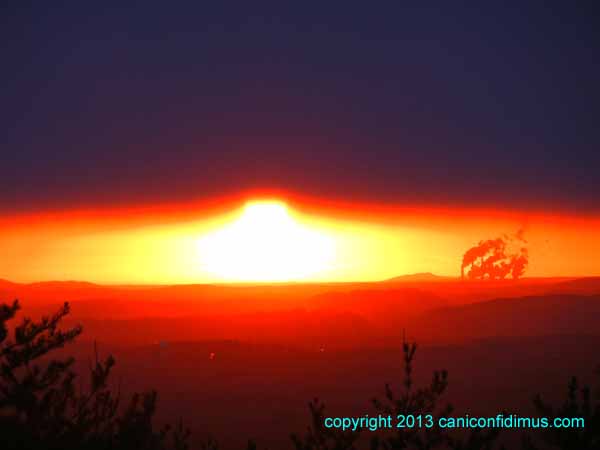
Sunrise, 15 January

It’s been a while since I posted a sunrise picture. This morning was nice. We had an almost complete overcast with a slim opening right at the horizon. The sun came up, peeked through the opening for a few minutes, and then disappeared into the clouds.

sunrise15jan14

The plumes on the right are from the Georgia Power coal-fired generating plant at Euharlee. Most of what looks like smoke is actually steam from the cooling towers. The plant is working fairly hard because the temperature dropped a little last night. Once the sun rose far enough that the clouds hid it, the wonderful red light disappeared, and now it’s just gray.

A few considerations on a recent report regarding a preferred orientation for a dog’s body along magnetic field lines during the process of elimination

(Note: Part of this post was published earlier today. Due to some problems, apparently mainly my ignorance of WordPress, it was incomplete at that time.)

I’m a keen observer of dog behavior, so I was naturally interested when the news media reported that dogs like to face north or south when they poop. The reports are based on a Czech-German study of the body orientation of dogs during defecation. The study finds that dogs prefer to align their bodies in the north-south direction when pooping. I’ve learned not to rely on the general news media for any real understanding of science, or anything else, so I decided to find the original study. It appears that the reports in the media are a reasonably accurate statement of the study’s findings. For a change. As far as they go.

The actual title is “Dogs are sensitive to small variations of the Earth’s magnetic field.”

To summarize: the researchers used a group of volunteer dog owners to record their dogs’ orientation during various activities, and finally concentrated on the process of defecation. They found that during periods when the Earth’s magnetic field is stable (not changing in direction or intensity), the dogs preferentially aligned themselves in a north-south direction. They did not do so during periods when the magnetic field was changing.

I didn’t do a deep analysis of the study, so I can’t judge the validity of the statistical results (assuming it’s not a complete hoax). It sounds a little flaky to me, especially since it relied on observations by ordinary dog owners, and also included no Doberman pinschers. I noted a fairly large number of small dogs, who can be notoriously contrary. Dachshunds in particular seem to be overrepresented. If the small dogs were even slightly suspicious about the nature of the study*, they would almost certainly have attempted to sabotage the results, just for the heck of it. Because that’s the way they roll.

Volunteer dog owners actually performed the observations. That’s not necessarily a fatal flaw, but it is a weakness. I assume the dog owners were told what to do, but not exactly why they were doing it. They presumably could have been familiar with the researchers’ previous, related work**, but whether that could have or did influence their observations is uncertain.

My own observations of dogs pooping are extensive. I don’t go out of my way to see it, but when you’re walking a dog and hoping that he will just please god get it over with it’s starting to rain harder, you really can’t help but notice. I have a lot of experience noticing it, going back at least to 1979, when I adopted Jesse, continuing through four other dogs and ending with our current two, Zeke and Lucy.

Based on my observations, small dogs, especially miniature pinschers, do not give a crap where they crap, or what direction they’re aimed when they do it. We have had Lucy for almost a year, and throughout that time I have taken her and Zeke on the same path around the house multiple times every day. I think a reasonable estimate of the number of trips is between 800 and 1000. By now I am pretty sure she knows the path, and could run it backwards blindfolded if food were involved. And yet when she feels the need to poop, which is surprisingly often, she stops wherever she happens to be and does it. Right in the path, where we will walk again within a few hours. It does not occur to her that if she went a few feet to the side of the path we would not have to treat the path like a minefield. Or maybe it does occur to her. Dogs have a different sense of humor from humans, and more different from female humans in particular.

I am pretty sure there is no preferred orientation of her body when the urge is acted on. The direction appears to be random. However, I will try to be more observant from now on. My iphone has a compass app, so I can check fairly easily, if I can remember to take it with me on walks around the house.

My observations of Zeke, on the other hand, indicate that there is a strong directional preference, but it does not involve the Earth’s magnetic field. If Zeke happens to feel the need to poop when we’re walking around the house, he goes into the woods, searches a while for precisely the best location, and unloads there. I don’t think he has shown a preferred compass heading for this process. If, on the other hand, he waits for our long walks down and back up the mountain, he does show a very strongly preferred orientation, but it is a matter of geographical gradient rather than the Earth’s magnetic field.

We live on a mountain, so for essentially our entire walk there is an uphill slope on one side of the road, and in places it’s quite steep. I know Zeke is looking for a rest stop when he climbs up and starts walking along the slope. When he’s ready, he turns to face downhill, with his rear end aimed up. And then he poops. He apparently is unfamiliar with the old saying about what direction poop rolls on a hill.

I don’t have a good explanation for Zeke’s behavior, but it is essentially 100 percent repeatable. I just figure he missed the heavenly doggy class on which way to poop on a mountain.

* It is not unlikely, in my opinion, that the researchers’ previous work in animal sensitivity to the Earth’s magnetic field would be know. Although, come to think of it, I doubt that many small dogs regularly read scientific journals, even if they are publically available online.

** It is far more likely that the dog owners could have read the researchers’ previous work, if for no other reason than that they are more likely than dogs to own computers.

Winter came knocking

It was 23 F when we got up Monday morning. It’s already been colder this winter, but this is the first time the Atlanta TV weather forecasters have been so excited (“The polar vortex is coming! Run! Run!”). The temperature slowly dropped all day.

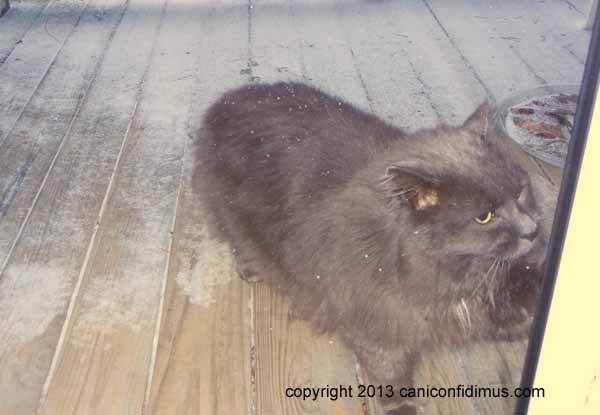
Leah was worried about the cats Sunday night, so we let Zoe, Smokey and Sylvester stay inside in addition to Chloe, who has been staying in since it got cold. But nature calls, so we put them out for a while in the morning.

Smokey did not like it.

Let me in

Let me in

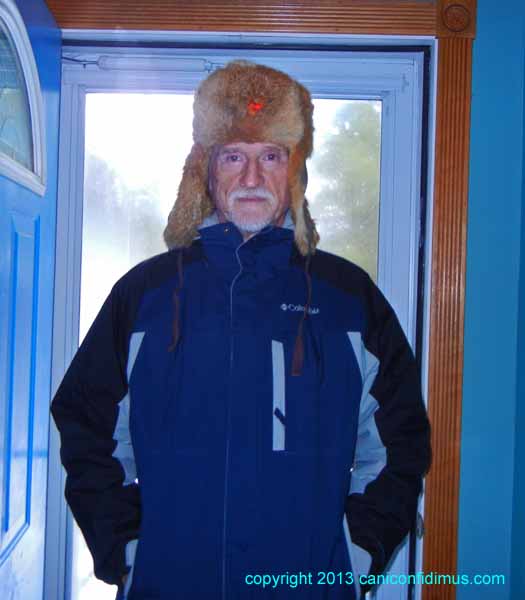
With the wind, it felt much colder than 23, so I thought Monday morning when I walked the dogs around the house it would be a good time to wear my LL Bean fur cap. My brother gave it to me a long time ago when he lived near Pittsburgh, but I haven’t had a good excuse to wear it until now. Plus I lost it for a while.

I was not as unhappy as I look here

I was not as unhappy as I look here

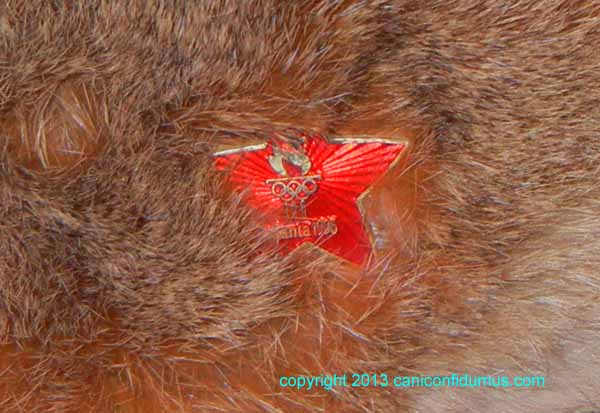
If you look closely you can see the red star from the Russian pin I got at the 1996 Atlanta Olympics. I think it fits the cap.

Russian star

Russian star

The dogs wore their winter coats when I took them out Monday morning. I didn’t take either of them for their usual long walk, but I did take Zeke for a shorter one. I left Lucy inside; small dogs lose heat faster than big dogs. We had a little snow overnight, and there were still a few flakes floating around when we walked. They were small and glittering, and they seemed to float more than fall. When a little breeze stirred them, they all took off in the same direction like a flock of birds.

Monday night was even colder. It was 6 F when we got up this morning (Tuesday). The dogs got two short walks around the house for purposes of nature calls, but only Zeke will get a longer walk, and he’ll have to wait till this afternoon when the temperature is supposed to reach 26. The cats, of course, stayed in Monday night, too. Unfortunately, Rusty and Dusty won’t come in, so they had to rough it in the cathouse or somewhere in the garage. I hope Dusty didn’t spend the night in a culvert.

The very low (for us) temperatures are an opportunity to see heat transfer at work. As you all know, wind chill is a great favorite of weather forecasters. One of the Atlanta guys said that it only refers to effects on humans, and that is partially correct. If the temperature is 35 with a wind chill of 20, a human will feel very cold without a coat, but a glass of water still won’t freeze. On the other hand, if it’s 6 F with a wind chill of -20 F, a house will lose heat much more quickly than it would in still air. We saw that last night. We (and by “we” I mean “I”) kept a fire going in our wood-burning stove all night, getting up twice to feed it. The stove kept the basement at around 77, but our bedroom dropped to 68 and the bathroom dropped to 66. Ice formed on the sliding glass doors with aluminum frames. And even with the stove going, our heat pump came on several times Monday night. Under more normal conditions, the stove alone will keep the house warm enough that the heating system doesn’t come on. Six degrees and wind removes too much heat from the house for the stove to keep up with it. At these temperatures a heat pump relies almost entirely on resistance heating, which is going to show up in our power bill.

The house complained about the temperature. The deck on the back and the front walk popped and banged all night as the wood shrank and rearranged itself.

This morning dawned clear. The sun is struggling to warm our bedroom and the living room, but I expect by afternoon the combination of the sun and the stove will have warmed the house enough that Leah can take off her anorak and mukluks.

These temperatures are not especially low for many places in the US, but they are for Georgia. Significant winter weather events are rare in Georgia. I remember them by their stories.

The first winter storm I remember was an ice storm in 1959 or 1960, when I was in elementary school. Rain fell onto cold surfaces and froze into a solid, glass-like coat. All night long we listened to the pine branches snapping off. They sounded like gunshots. The limbs fell onto power lines that were already sagging from their own ice coating, and the lines broke. We lost power for a long time. Our house was heated with a floor furnace, and, of course, the thermostat didn’t work without electricity. But my father went under the house and managed to get the furnace to run steadily without electrical power. I think we were the only ones on our street with heat.

The next I remember was a cold snap a few years later that happened after a lot of rain had caused the streams and rivers to flood. Ice formed on the on the flooded creek where my father took my brother and me and our dog Mike for a walk. Mike went out on the ice and fell through. We heard him barking. We went down to the edge of the ice and called and called. He struggled, putting his front feet on the ice and trying to haul himself out, but every time he got up, the ice broke under him. He finally pulled himself out. I don’t know what would have happened if he had not been able to get out. My father would not have gone after him and left us there, and he certainly never would have let us go after him. I know what I would do today if it happened with Zeke or even Lucy.

The next one was the winter of 1984-1985, when I was in graduate school at Georgia Tech. I lived in a small apartment at the back of a house two blocks from Northside Drive and about two miles from school. When I drove back to my apartment after school, the snow was coming down in hard little balls, but the streets were clear. As I always did, I took my dog Jesse to a field across Northside, where I let her run for a half hour or so. By the time I had changed my clothes and walked the two blocks to Northside, cars were sliding sideways down the hill. The storm hit so quickly that some of the faculty in the Atmospheric Sciences Department were caught by surprise and had to spend the night at school.

Later that evening I was watching TV when my roommate, an undergrad, came in with a young female student. The girl stayed a few minutes and then said she was going to her apartment. I thought she had driven my roommate home, but I finally put two and two together and asked him if they had walked from campus. When he said they had, I said we couldn’t let her try to walk home. She was planning to walk about 10 miles out beyond the perimeter road through the snow in a dress and open shoes. That’s when I came up with my first rule of life: Never wear shoes you can’t walk home in.

We got into my little Honda station wagon and started out. By that time the roads were nearly impassible, and what was passable was usually blocked by cars driven by idiots. We spent about two hours finding a way out to the girl’s apartment, going first one way, and then another. The snow was already so deep that at one traffic jam I turned around in a parking lot and drove over the curb without realizing it.

When we let the girl out at her apartment, I think she said thanks.

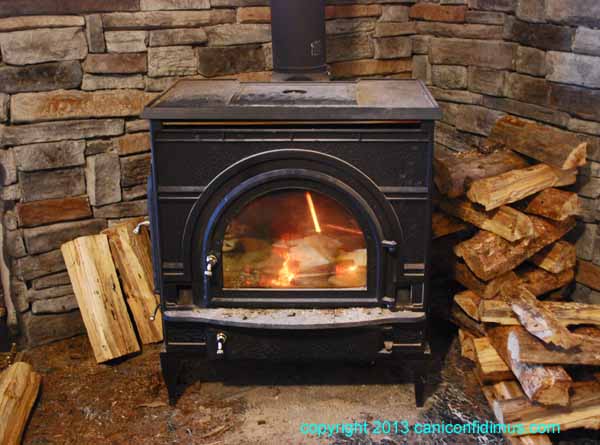
This weather is severe, but I don’t think I’ll have a story for it. It’s just cold, and the stove is warm.

stove

Possum and persimmon update

I don’t think I have to make the case that possums like persimmons. That seems to be pretty much common knowledge, even way up in Chicago:

“Moonlight hunts, hound dogs, and possums grown fat on persimmons and roasted with sweet potatoes, are justly celebrated in songs and stories about country life down south.”

At least that’s the way this Web site puts it.

We don’t do hunts by moonlight or otherwise, and we don’t eat possums with sweet potatoes or without. We do have a dog with at least some hound in him, and we do live in the country down south. And the possums are eating persimmons.

In fact, a possum has nearly stripped the persimmon tree I mentioned in an earlier post. I counted four persimmons left on the tree today. A couple of days ago a lot of the fruit was gone, but there were still quite a few out on the long, thin branches. When I saw the possum in the tree a few days ago I wondered what it would do about them. Now I think I know.

I mentioned in another earlier post about finding small branches lying on the ground under the tree with ends neatly chewed into small cone shapes. I think the possum has been chewing the branches off, letting them fall to the ground, and then climbing down and eating the persimmons. It doesn’t seem to find all of them, though. For the last few days Zeke, the part hound dog, has been sniffing out the persimmons the possum misses and eating them.

I haven’t actually seen the possum eating persimmons in the tree, chewing branches off the tree, or eating persimmons off the ground, but I’m pretty sure the case has been made.