Turtle twice seen

We seldom see turtles up here on the mountain, but last week I had two sightings, and I am pretty sure it was the same turtle. That’s the first time I have been able to identify the same turtle on two separate occasions.

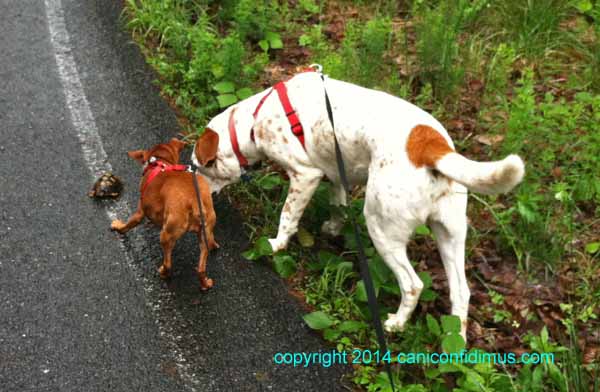
Here he (she? I didn’t check) is on Fouche Gap Road.

turtle thursday


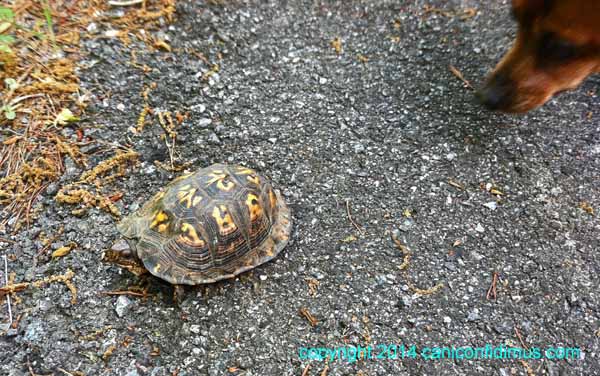
Lucy’s snout is in the picture for size reference (I guess I need another reference so you can tell how big she is; not big.) This turtle was facing the edge of the road, so I wasn’t too worried about leaving it where I found it.

Two days later we found a turtle at the same place, but heading into the road.

turtle saturday

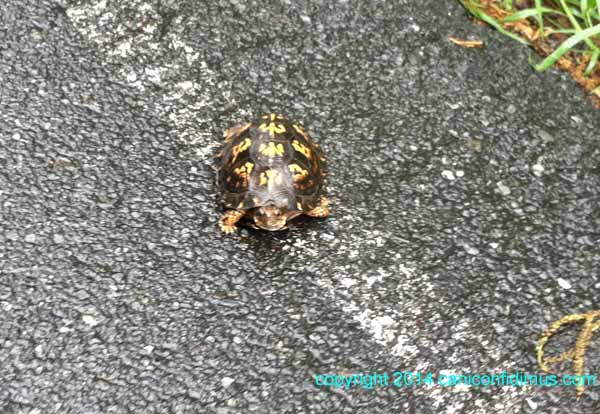
I don’t know for sure that it was the same turtle. Here’s a somewhat closer shot.

saturday turtle 2

There is some glare on the shell, but it seems to me that the patterns on shell are the same on both occasions, so I assume it is the same turtle. I took this picture with my iPhone, so it won’t bear any more enlargement.

This section of the road is just past and on the inside of a fairly sharp curve, so it would be a dangerous place for a turtle to spend much time. I moved it just off the pavement and faced it away from the road. Of course if the turtle knew where it wanted to go, that might not have done much good.

Now that I know where to look, I’ll check this area Monday when I take that path for the dogs’ walk.

Red dirt hog

A few days ago Leah and I were privileged to sight one of the rarest animals in this area. It is so rare that most scientists insist that it does not exist today, if it ever did. Confirmed sightings in its what is considered to be its normal range are next to nonexistent. There have been only a handful of unconfirmed sightings on the mountain, and even locals dismiss those as hoaxes or misidentifications. But we saw one, and we took its picture: the Lavender Mountain red dirt hog (sus erymanthus enluvius).

Red dirt hog surfacing to breathe

Red dirt hog surfacing to breathe

While most people are aware that hogs like to wallow in mud because of a lack of sweat glands and a disposition generally disinclined to excessive concern with personal grooming, few know that many millennia ago, an isolated group of surface hogs living in the Mississippi River Valley slowly evolved so that they could burrow deep into the sediments of that region. Over the following eons, they developed the sharp digging claws and streamlined physiques necessary for spending most of their time diving deep into the earth searching for their prey, the dirt krill. Most fundamentalists deny that surface hogs could have evolved into the dirt hog and insist on a special creation, possibly by the devil, since dirt hogs were historically known to cause extensive damage to crop fields as they surfaced and dived.

Early settlers moving west across the Appalachians confused the dirt hog with the groundhog, attempting to pet them when they surfaced. That resulted in the loss of quite a few fingers and was largely responsible for the dirt hog’s reputation for viciousness. However, it is thought today that the dirt hogs in these cases actually thought they were grabbing earthworms due to their poor eyesight. Nevertheless, it is not advisable to try to pet a dirt hog.

It is thought that the dirt hog slowly colonized eastward from the Mississippi River Valley, following tributaries, until they reached the Appalachian Mountain Range. At that point they advanced southward until they reached the Gulf and Atlantic coastal plains. That then allowed them to proceed up rivers in those regions, eventually landing them as far north as this area.

However, according to the best-known and most reputable cryptozoologists, they should be confined to areas of deep sedimentary deposits, like the flood plains around larger streams and rivers. Conventional science predicts that the dirt hog cannot tunnel through rocky areas, and since they cannot survive long on the surface, they should not be able to reach the top of the mountain. This finding conclusively refutes that position.

We plan to report this sighting to the investigative branch of the National Dirt Hog Association.

Solenopsis invicta (or wagneri)

The first time I heard about fire ants was about 50 years ago when I was in junior high. It was in Mr. Dorsey’s sixth or seventh grade science class. He was scornful of a state program to eradicate fire ants in south Georgia by aerial spraying of insecticides. He said it would never work; what they needed to do was inject poison into each fire ant nest individually.

That would have been a more ecologically sound approach, since aerial spraying would kill lots of other potentially beneficial bugs and would have killed very few fire ants. Mound-by-mound poisoning might have provided some control in limited locations, but it would have been impossible to find every nest.

For the next couple of decades I didn’t think once about fire ants. And then, one day when I was in graduate school in the early ‘80’s I took at run out into the country behind my parents’ house. For some reason at about the two-mile point I stopped, maybe to take a breather or to let a car pass. I happened to stand in tall grass right on top of a fire ant mound. It was only a matter of seconds before at least one fire ant made it over my shoe and sock to my ankle, where it stung me.

At that point I started noticing fire ant mounds, and once I started noticing them, they seemed to be everywhere. Most sources say they were originally introduced into North America at the port of Mobile around 1940. For a while it seemed like the invasion of fire ants was unstoppable, and they were going to spread and overwhelm everything. The limit to their range seems to be low temperatures and dry conditions.

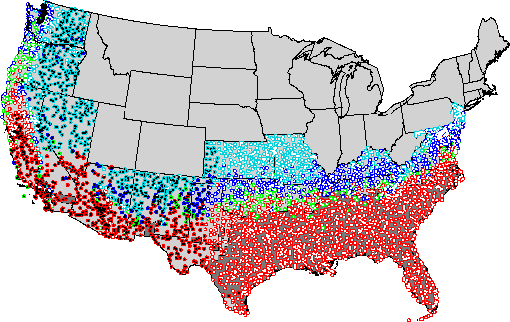
This is a USDA map that shows the potential range of fire ants. The lightest blue indicates areas where expansion of the range is unlikely. The red is areas with confirmed populations.
fireantrange

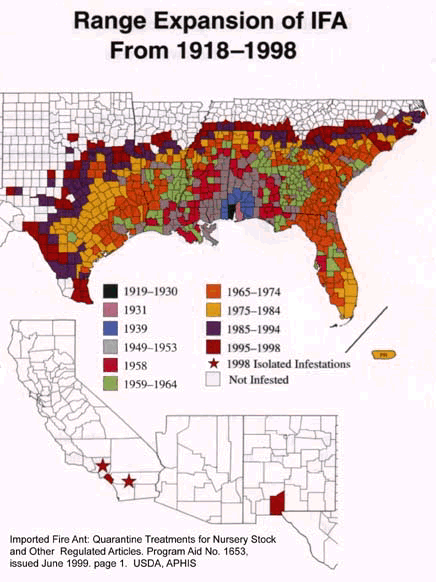
This is a USDA map on a University of Texas site showing the history of the fire ants’  expansion:
ifaustdist

If I’m reading the map correctly, Floyd County, where we live, is in the 1975-1984 expansion, which is consistent with my impress of when they started showing up around here.

If you don’t have fire ants, you can consider yourself lucky. They are extremely aggressive when defending their nests. If the nest is disturbed, they swarm out in masses and, if you happen to be in the way, they swarm up your feet until they find flesh, and then they latch onto your skin with their pinchers and swing their abdomens around as they sting repeatedly.

I have read at least one Web site that compared the pain intensity of various stings. This site gives a fairly low ranking to the fire ant sting, below a yellowjacket. It’s hard to remember pain levels from 30 years ago, but my impression at the time was not consistent with that. I would have ranked it about the same as a yellowjacket sting, but with longer-lasting effects.

These days my overall impression is that fire ants seem to have reached some kind of equilibrium population. I don’t seem to see as many mounds along the side of the road as I used to. That’s far from a scientific observation, though, and my impression may be wrong. The extension service mentions a pathogen (among other natural enemies) that attacks fire ants. Maybe that has something to do with it.

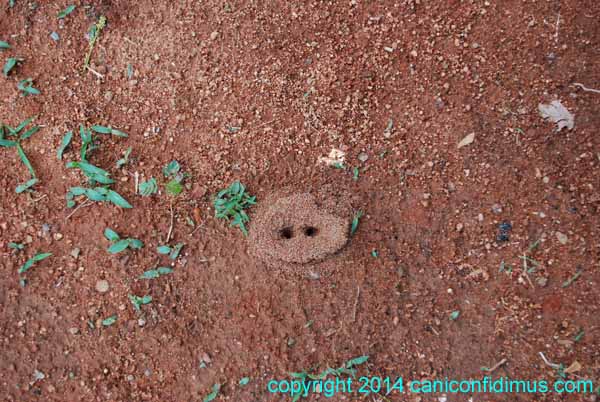
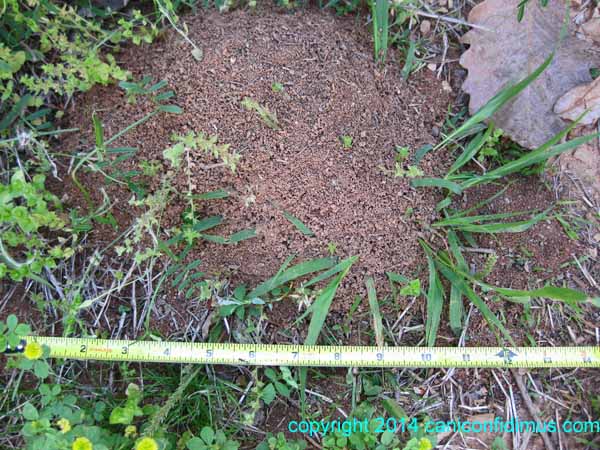
This is a fire ant nest behind our house. It’s a foot away from an existing nest which I disturbed about a month ago when I borrowed some dirt to use in another place in the yard. You may have trouble reading the tape measure; the mound is about a foot in its widest dimension. It’s a relatively small nest at this point.
fireantnest

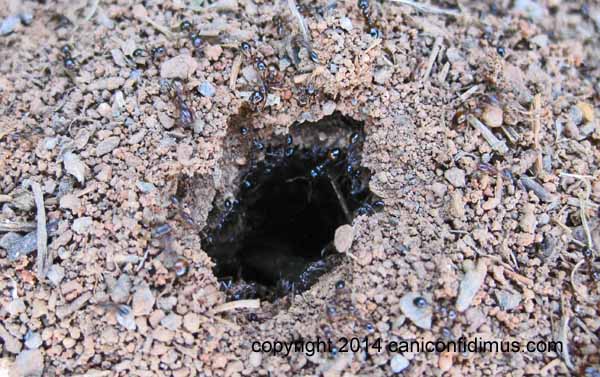
The nests are quite deep. It’s easy to drive a stick six inches into such a nest, which I did.
closerviewofants

I tried to manipulate the image so the ants are more visible. These ants are darker than the typical red fire ants I most often see around here. I keep my distance when I do something like this. This nest is in line for a dose of fire ant poison, which seems to either kill the nest or drive the ants to some other place.

If you have ants you think might be fire ants, I suggest that you not stick a finger into the mound to test it. Instead, try identifying them by pictures like these.

The title shows the popular scientific name Solenopsis invicta. However, these fire ants were first identified and named wagneri. At this point I’m not sure which name will win.
The green curtain

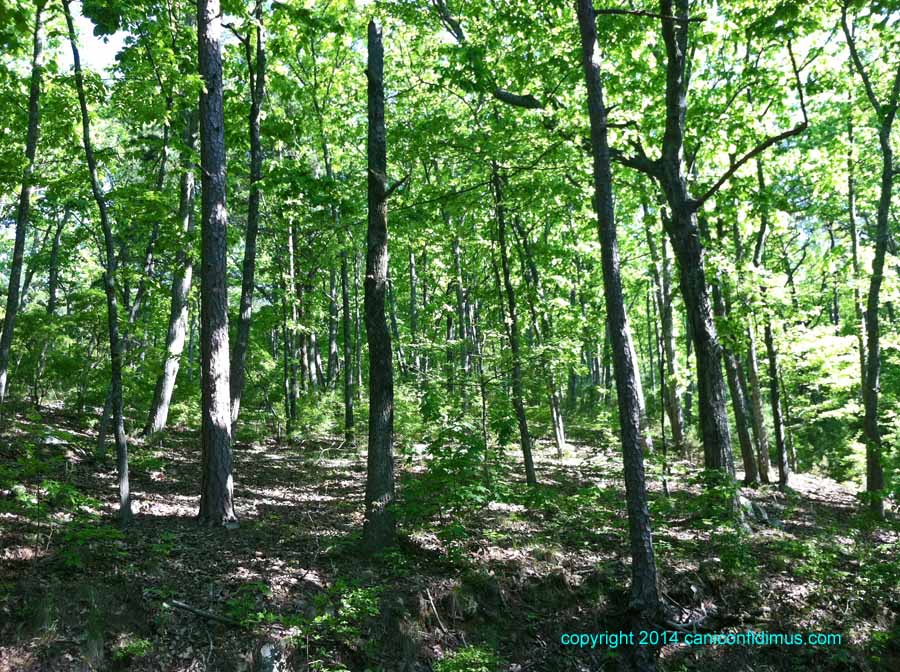
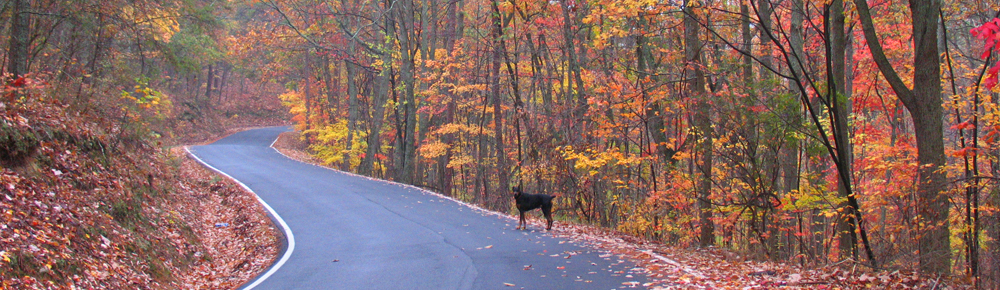
The woods around the mountain have closed the green curtain. Just a few weeks ago the view into the forest from Fouche Gap Road was open. Now the trees have leafed out and all that’s visible is succeeding planes of green. I suppose the view is somewhat more open if you walk into the woods, but every plant is greedy for sunlight, so they wall in the open road with leaves.

Every level of the forest is green, from the ground up. The upper levels and the understory trees are green. The muscadine vines are green. Even the beds of poison ivy are so lush and that they look almost inviting.

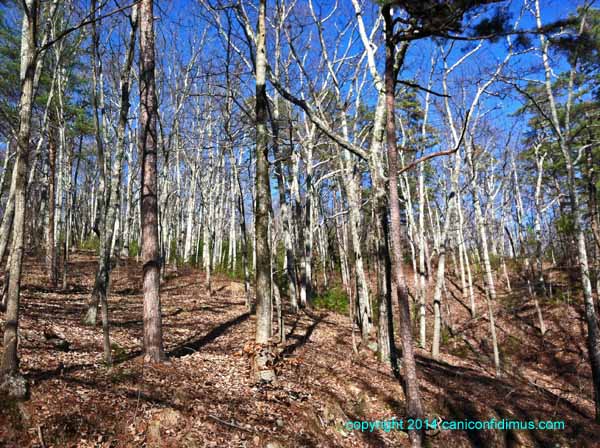
This is the view from Fouche Gap Road back in December. It wasn’t so very different a few weeks ago.

open forest

This is a view from almost the same place taken Friday. It’s a view looking up the mountain. This particular location doesn’t have as much lower growth, so the view is less obstructed.

green closed

The leaves are so new some trees haven’t quite finished filling them out. The maples seem to be behind the oaks, with the hickories somewhere in between. But even the oak leaves are still soft. I cut a couple of chestnut oaks close to the house and within a half an hour the leaves had wilted like frozen lettuce.

Walking down the mountain in the cool of the morning with the birds singing somewhere out of sight is uplifting. It’s easy to understand why humans associate spring with rebirth.


Zeke and my knee

Not quite a week ago I was taking the dogs for their last walk of the evening when Zeke saw, heard or smelled something (or thought or hoped he saw, heard or smelled something) in the woods behind the house. He took off. I tried to stop him, and he jerked me forward a couple of steps as I tried to brace with my right leg. I came down hard on that leg and a sharp pain stabbed through my knee. I fell and rolled over. I held my leg up to my chest and hoped that the pain wouldn’t last long.

Of course I had to let go of the leash, but Zeke made it only about 30 feet before the leash snagged on a tree. After the pain eased, I limped down to him, grabbed the loose skin on his neck and explained that he should not do that again.

He said nothing.

My right knee is still giving me problems. Not much right now, but enough that I need ibuprofen for it. If I take ibuprofen before bed, my knee feels better when I get up in the morning, but I have to take another dose before I walk the dogs. For a few days I had to take little baby steps when going downhill. I still have to be careful, but it’s improving. I wasn’t sure at the time, but it looks like it’s going to stop hurting eventually and I won’t need to start shopping for a new knee.

I should have been better prepared. Zeke had been staring out into the night from the sliding glass door in the living room. When we went out, he had his alert look: head up, ears up, tail up. It’s hard to get him out of that mode if he thinks there’s something out there, but I should have tried harder. Or, I could have just let him go when he took off and not tried to stop him.

He’s a good dog most of the time. He just needs a little tweaking in the obedience-in-the-face-of-critters-in-the-woods department.