Zeke’s latest experiences off the leash

Faithful readers know how little I can trust Zeke off the leash. We keep thinking maybe if we try enough times, he’ll learn. So last Wednesday I gave it another try.

I have been working to locate exactly where our new house should go, and to figure out where to put the driveway. On Wednesday I loaded Zeke and Lucy into our side-by-side four-wheeler (it’s a Kawasaki Mule), and rode the few hundred feet to our new lot. It’s literally within sight of our current mailbox, but I take the Mule because I can’t carry a chainsaw, handsaw, axe, loppers, 300-foot tape measure and the rest on foot. As soon as we got to the center of the property, Lucy headed for home. She’s not the pioneer type.

I put a 12-foot leash on Zeke, figuring that if he wandered off, he would get tangled in the woods and couldn’t get far. I thought I could find him when he started barking for help. That worked for a while, but eventually he drifted off uphill into the woods. I didn’t worry much at first, since I really thought he couldn’t get far. After all, I had had to untangle him several times as we walked around. But he was gone, and he didn’t come when I called.

About an hour later I heard Leah calling from the street. We had spoken on the phone and I had told her that Zeke was loose, so she was watching for him on the way back from the dentist. She finally saw him lying in the woods near the front of our property. He limped when he came to her. I came down to the car and we found that he had nearly torn off his right dewclaw. Leah took him home and I packed up and followed.

As soon as I got home I phoned the vet, and they told me to bring him in right away. It was supper time for the dogs, so I offered him an animal cracker. He refused, which I attributed to pain. It turned out it was probably something else all together. It was almost exactly a year ago that Zeke got loose and gorged on something that looked like stew beef when he threw it up. This was a repeat.

Our vet is on the other side of town, about a half hour away. Zeke had started whimpering by the time I got him in the car, so his dewclaw must have been hurting. It certainly looked painful. The vet removed the nail but saved the nail bed; it should grow back. They had to sedate him to do it, so he was pretty groggy on the way back home. When I got him home, I found a double handful of meat that he had vomited up in the back seat. Fortunately he was lying on a canvas tarp, which caught all of it.

He ate a couple of dog biscuits and everything seemed OK. I took the dogs out at bedtime and nothing seemed amiss. About an hour after we went to bed, the sound of Zeke’s claws on the dining room tile woke us up. I put on some clothes and took him out. I was so sleepy I don’t even remember whether he did anything. We went back to sleep, and he woke us up again around 6, which is earlier than us old, retired people get up. I took him out again, and he relieved himself, I think. Before I could get back in bed, Zeke started making the “urk” that signifies that a dog is getting ready to vomit. He was standing in the middle of the bedroom carpet. I grabbed him and tossed him into the dining room, where he promptly threw up way more than another double handful of meat.

This was one of the worst messes I have ever seen, or smelled. I told Leah that if he had done it in the bedroom, we would have had to replace the carpet. The first time this happened I thought the meat he threw up looked too much like grocery store beef to be a wild animal that he had found or killed. But now I have to conclude that that’s exactly what it was. I have seen no sign of whatever it was.

Here’s the bottom line: Zeke’s dewclaw is not giving him any problems, he’s almost over whatever he ate, and he’s never going to wander free in the woods again.

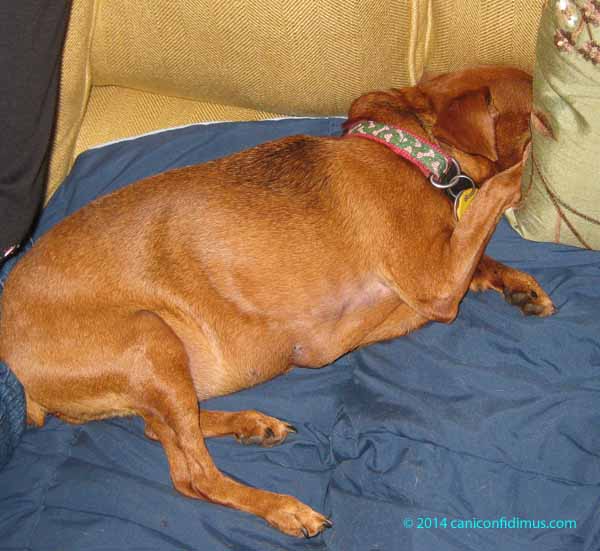
Zeke is a gentle, affectionate, fairly obedient dog about 95 percent of the time, but I think that somewhere down inside, he has a streak of the wild, of the wolf. I probably wouldn’t have been surprised to find that out about a Doberman pinscher or maybe a German shepherd, but Zeke looks too goofy to have a wolf hidden inside. I mean, look at that face.

innocent zekeIs that the face of a relentless predator?

I couldn’t go back to sleep again after cleaning up Zeke’s mess, but at least I did get to see this from the deck.


sunrise4november2014


Hanging on

The persimmon tree has lost all its leaves, and the hickories have lost most of theirs. However, they are still hanging on to some of this fall’s fruit.

persimmons and hickory nuts

The possums have been working on the persimmons, but the last ones are just too high in the tree to reach, and the limbs are apparently too thick to easily chew through. These persimmons will almost certainly last into next year.

Studied indifference

Back before my mother died, her little dog Lucy almost always found a place on Mother’s furniture if not on her lap. Since we inherited Lucy we haven’t let her on our sofa much, but occasionally Leah lets her up. She likes to bury her head under a pillow like this:

lucy hides her head

Smokey the cat also likes to jump up on the sofa between Leah and me. He does a little nesting, usually testing how soft my leg is, and then settles in lying as close as he can to me. Odd, since Leah is the cat person and I’m the dog person. I do usually give him an ear massage, and he turns his purr machine up to 11.

Smokey and the rest of our cats get along reasonably well with the dogs if their paths happen to cross, but they usually retreat pretty quickly when the dogs get too nosy. The other night Smokey and Lucy found a way for both of them to get their full sofa time.

lucy and smokey 2They ignored each other.


House rules

First of all, Leah and I want to wish everyone a happy Thanksgiving. We hope you can spend it with people you care about, and we hope you get plenty of good food to eat.

(Updated) I’m certainly not an expert in home design, floor planning or house construction, but after looking for my first house in Alabama, building our current house and planning for our next house, I have some opinions. Some are consistent with standard home design, and some are just my personal view, so take them for what they’re worth. The rules are oriented towards designing a house, but I think you should keep them in mind if you’re looking for an existing house

The first rule is to design your house for the next owner. Quirkiness, eccentricity or even just out-of-the-ordinary taste may suit you, but it’s unlikely to be anyone else’s idea of what a house should be. It doesn’t matter if you think the next house will be your last, because it’s impossible to predict what the future holds.

When I was looking for a house outside Huntsville, Al, my real estate agent showed me a house that a retired couple built. It was an earth-sheltered, passive-solar house with a linear floor plan, like an old roadside motel. There was no central heating or air conditioning. Apparently the owners had read too many enthusiast articles about the virtues of earth sheltering and passive solar heating. As great as they may be, neither works particularly well in Alabama. They had installed a window air conditioner through a wall so that it stuck out into the garage, and then cut holes and put fans in the walls to try to pass the cool air or heat from the wood stove from the living room to the bedrooms. It was their own, personal vision, and it was supposed to be their final home, until they decided to move to Florida to be close to family. It was still for sale years later.

Build the house you want, but make sure it suits the needs of other buyers in your area. If every house in your area has a basement, your house needs a basement. If every house has three bedrooms, your house needs three bedrooms. If every house has central air conditioning, your house needs central air conditioning. If every house has an attached garage, your house needs an attached garage. If every potential home buyer is not a kooky hippie, don’t build a house that only kooky hippies will want.

The second rule is an extension of the first: building a workable house plan from scratch requires hard, thoughtful, informed work. The requirements for practicality tend to control floor plan layout, and every single requirement has to be remembered and met in some way. That’s why if you look at many house plans, they start to look alike.

The third rule is that a house design should meet certain standards for appearance and utility. For example, the tops of windows and the tops of doors on a given side of a house should all be at the same level. If you see a house that happens to violate that rule, you will probably think something looks odd even if you aren’t consciously aware of what the problem is. Ignore that rule and the next buyer swill probably feel some level of discomfort when they look at the house, and discomfort doesn’t sell houses.

The next rule is that a house should be designed for its location. (This is actually such an important rule that it should probably be No. 1.) A house on a slope should probably have a basement. If the slope is steep, the house should probably have a linear layout with the short axis aligned with the slope. If it’s in a hot climate, the roof overhang should be deep enough to provide shade for windows and the sides of the house. If it’s in a cold or even moderate climate, windows should be concentrated on the south-facing side. If there’s a view, put some windows so you can see it.

As a result of Robin’s comment, I came back here to add an important rule as a corollary to the preceding rule. In a climate that requires some heating, taking advantage of the sun’s energy just makes sense. There’s something really satisfying about sitting in a sunny room and being nice and warm when it’s freezing and the wind is blowing outside — and the heat never comes on. Even if a house is not specifically designed as a passive solar house, if the site conditions allow it, there should be windows that can gather some of the sun’s heat in the winter. The slope on our new property prevent having the house face due south as I would prefer. Doing so would introduce features that we’re trying to eliminate, like very high eaves. But we’re going to put deep windows on the southeast and southwest sides to get as much sunlight as we can.

The next rule is that every plumbing fixture should be as close as possible to a water heater. Many (most?) house plans I have looked at ignore this rule because it’s just so convenient to scatter bathrooms all around the house. Put the master bath at one end and the guest bath (or kids’ bath) at the other end, with the kitchen somewhere in between. If the floor plan does that, some provision must be made to get hot water to every outlet quickly, or someone ends up waiting too long for hot water. There are ways to get around it, like recirculating pumps and on-demand heaters, but they tend to cost more. The best plans have a plumbing core, with kitchen, bathrooms and laundry room centered close to the water heater.

The next one is tricky. If you want a 1500-square-foot house, and you want rooms that add up to 1500 square feet, you can’t just draw a rectangle that’s 30 feet by 50 feet.Walls have thickness. Exterior walls are at least six inches thick, and interior walls are around five inches thick. You can either have a 1500-square-foot footprint and smaller rooms, or rooms that add up to 1500 square feet and a larger footprint, not both.

I have some personal rules, or at least inclinations. One is that I don’t like halls; they waste space that could otherwise be used for rooms. Unfortunately, it’s really hard to avoid halls, and I haven’t figured out a way to get around using them. Another is that bathroom walls should be sound-proofed or the bathroom should be located so that the walls don’t adjoin living spaces, especially living rooms, dining rooms and kitchens.

There are so many rules that it’s hard to list them. You know some of them, but you might not be aware of them. For example, every time you enter a room, you expect to find a light switch at a certain height and location next to the entry. If there are two exits for a room, like a living room or kitchen, you’re going to expect to be able to turn off lights at each exit so you don’t have to feel your way through a dark room. When you walk into the house and take your coat off, you’re going to look for some place to hang it up. Vacuum cleaners, sheets and towels need storage.

It’s hard to meet all the requirements even if you know about them. Our current house doesn’t meet all of them. For example, we don’t have a plumbing core. The guest bathroom is out in Siberia, so I end up washing my hands with cold water when I use it. I don’t like a plan that makes it look like you live in a garage with a house attached as an afterthought. Our house looks exactly like that; the first thing you see when you pull into the driveway is the garage.

I have tried to keep the rules in mind while designing our next house. The garage in our next house will be hidden at the back. Our next house will have the plumbing fixtures closer to the water heater, although we won’t quite have a plumbing core. I changed the placement of the master bedroom and living room to take advantage of a view that I didn’t realize we would have.

Last night I thought I was finished with all but the details and was in the process of making a model of the house with foamcore boards. And then when I was taking a shower and thinking about this post, I realized that I had violated my first rule. I had planned for a deck on the front of the house that would have no ground access, which had necessitated putting the main entry on the least accessible side of the house. I realized that layout would look ridiculous, if not crazy, to anyone else. And Leah didn’t like it either.

So now we’re going to have access to the ground from the front deck, and a front door that is actually on the front of the house. Once I got to that point, several problems I was working with suddenly disappeared.

It seems that the rules actually have a reason behind them.